Wed, Sep 30, 2026
[Archive]
Volume 3, Issue 2 (Winter 2025)
CPR 2025, 3(2): 63-66 |
Back to browse issues page


Download citation:
BibTeX | RIS | EndNote | Medlars | ProCite | Reference Manager | RefWorks
Send citation to:


BibTeX | RIS | EndNote | Medlars | ProCite | Reference Manager | RefWorks
Send citation to:
Sobhanian P, Hosseinzade M, Farnia S. Mental Health Disorders in Pediatric Patients With Type 1 Diabetes in Mazandaran. CPR 2025; 3 (2) :63-66
URL: http://cpr.mazums.ac.ir/article-1-165-en.html
URL: http://cpr.mazums.ac.ir/article-1-165-en.html


Department of Psychiatry, Psychiatry and Behavioral Sciences Research Center, Faculty of Medicine, Addiction Institute, Zare Hospital, Mazandaran University of Medical Sciences, Sari, Iran.
Full-Text [PDF 431 kb]
(74 Downloads)
| Abstract (HTML) (173 Views)
Full-Text: (45 Views)
Dear Editor
Type 1 diabetes mellitus (T1DM) is a chronic autoimmune condition characterized by reduced insulin production, leading to elevated blood glucose levels [1]. It typically begins in childhood or adolescence [2], and children and adolescents with T1DM are more vulnerable to psychiatric comorbidity, which may hinder self-management and worsen clinical outcomes [3-5]. This concern was especially relevant during the COVID-19 pandemic [6], a period associated with quarantine, social disruption, and health-related stress that may affect psychological well-being in vulnerable pediatric populations [7].
Evidence from Mazandaran Province demonstrated a considerable prevalence of depression, anxiety, stress, and symptoms consistent with post-traumatic stress in the general population during the COVID-19 quarantine period [8], underscoring the substantial psychosocial burden of that time. Furthermore, a Swedish cohort study reported that children with both type 1 diabetes mellitus and psychiatric disorders consistently experienced poorer long-term educational outcomes [9]. Routine early screening for mental health disorders in individuals diagnosed with diabetes is recommended, as it may contribute to improved health outcomes [10].
This cross-sectional census study examined the prevalence and pattern of psychiatric disorders among children and adolescents with T1DM during the COVID-19 pandemic, an issue of growing clinical importance. The study was carried out at Bou-Ali Sina Hospital in Sari, Iran, between January 2021 and January 2022. Eligible participants included all outpatient children and adolescents younger than 18 years with a confirmed diagnosis of T1DM who were receiving follow-up care at the pediatric endocrinology clinic. During the study period, all participants were referred to the child and adolescent psychiatry clinic, where a child and adolescent psychiatrist performed sequential evaluations using the semi-structured schedule for affective disorders and schizophrenia for school-age children–present and Lifetime Version (K-SADS-PL) diagnostic interview [11]. The study was approved by the Ethics Committee of Mazandaran University of Medical Sciences, and written informed consent was obtained from parents or legal guardians.
The study population consisted of 405 children and adolescents, including 211 girls and 194 boys. The mean height of participants was 1.42±0.22 m, with values ranging from 82 to 186 cm. The corresponding mean values for body weight and age were 38.94±18.02 kg and 14.29±4.99 years, respectively. Psychiatric comorbidity was detected in 174 participants (42.9%). The most frequently observed psychiatric conditions were adjustment disorder (ADJ) (27.6%), generalized anxiety disorder (GAD) (7.1%), and attention deficit hyperactivity disorder (ADHD) (5.4%) (Table 1).
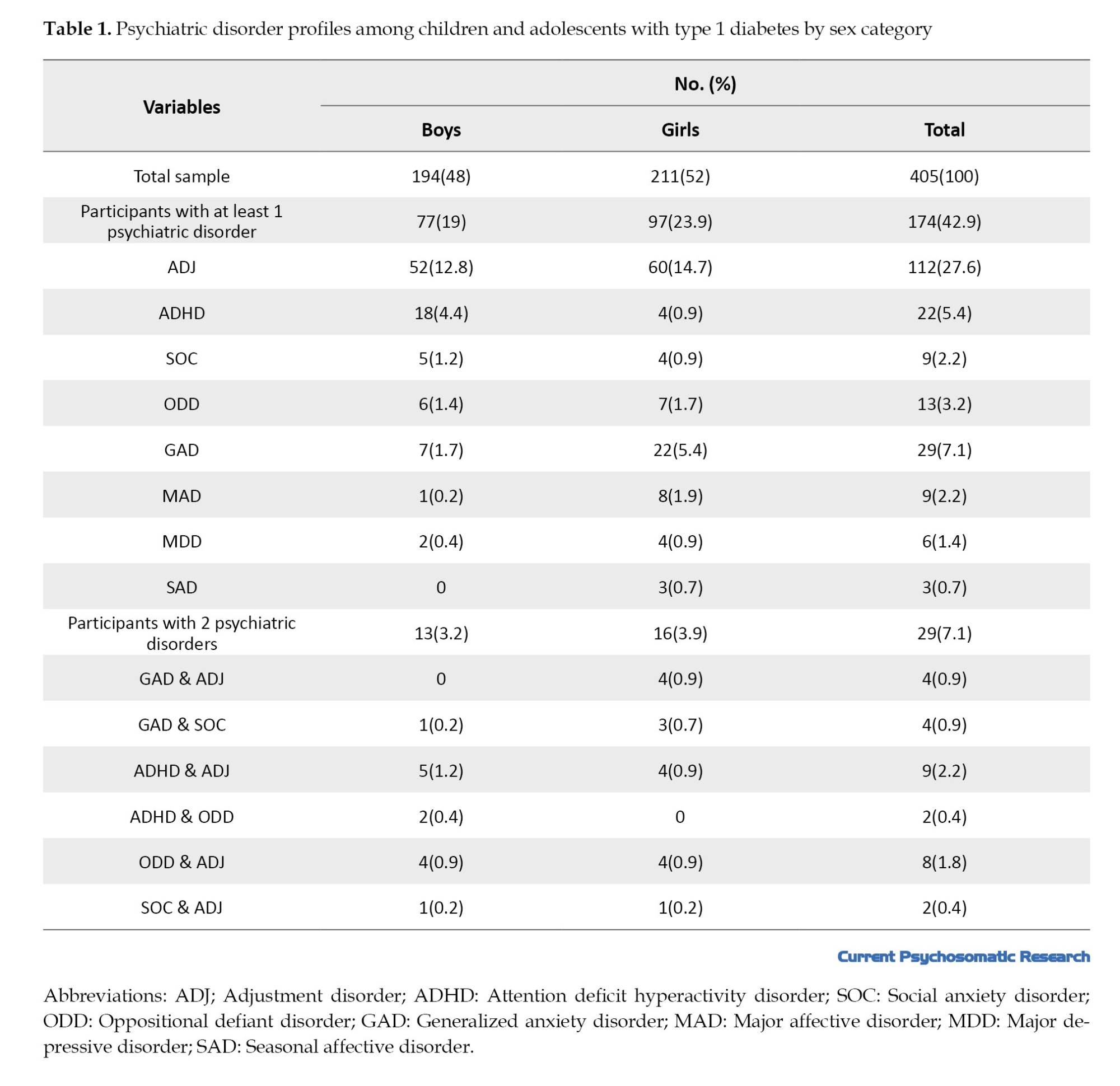
The elevated frequency of ADJ observed in our study is in agreement with previous evidence suggesting that children living with chronic diseases such as T1DM may encounter substantial difficulties in psychological adaptation [12]. Similarly, the rate of GAD identified in our population corresponds with earlier studies reporting increased anxiety symptoms among children and adolescents with T1DM [13]. Although ADHD occurred less frequently than ADJ and GAD, variations in its reported prevalence across studies may be attributable to differences in study design, diagnostic approaches, or participant characteristics [14, 15]. Other psychiatric conditions were identified less commonly; however, psychiatric comorbidity appeared to be more prevalent among girls. In contrast, ADHD and social anxiety disorder (SOC) showed relatively higher frequencies among boys. The coexistence of multiple psychiatric conditions, particularly combinations involving ADHD with ADJ and oppositional defiant disorder (ODD) with ADJ, indicates that co-occurring psychiatric disorders may occur in pediatric and adolescent patients with T1DM and could add complexity to diabetes management.
Collectively, these findings characterize the frequency of psychiatric disorders among young individuals with type 1 diabetes during the COVID-19 period and underline the necessity of systematic mental health evaluation and coordinated care approaches. Because the study is cross-sectional and lacks a pre-pandemic comparison group, the findings should be interpreted as descriptive of this period, and causal inferences regarding the effect of the pandemic cannot be made. During this time, factors such as social isolation, disrupted routines, worries about health and infection, and uncertainty may have contributed to psychological strain, depression, and anxiety, which can complicate diabetes management. A major limitation is the absence of a pre-pandemic control group; future longitudinal studies with comparison groups are needed to examine whether the prevalence of psychiatric disorders differs across periods.
Type 1 diabetes mellitus (T1DM) is a chronic autoimmune condition characterized by reduced insulin production, leading to elevated blood glucose levels [1]. It typically begins in childhood or adolescence [2], and children and adolescents with T1DM are more vulnerable to psychiatric comorbidity, which may hinder self-management and worsen clinical outcomes [3-5]. This concern was especially relevant during the COVID-19 pandemic [6], a period associated with quarantine, social disruption, and health-related stress that may affect psychological well-being in vulnerable pediatric populations [7].
Evidence from Mazandaran Province demonstrated a considerable prevalence of depression, anxiety, stress, and symptoms consistent with post-traumatic stress in the general population during the COVID-19 quarantine period [8], underscoring the substantial psychosocial burden of that time. Furthermore, a Swedish cohort study reported that children with both type 1 diabetes mellitus and psychiatric disorders consistently experienced poorer long-term educational outcomes [9]. Routine early screening for mental health disorders in individuals diagnosed with diabetes is recommended, as it may contribute to improved health outcomes [10].
This cross-sectional census study examined the prevalence and pattern of psychiatric disorders among children and adolescents with T1DM during the COVID-19 pandemic, an issue of growing clinical importance. The study was carried out at Bou-Ali Sina Hospital in Sari, Iran, between January 2021 and January 2022. Eligible participants included all outpatient children and adolescents younger than 18 years with a confirmed diagnosis of T1DM who were receiving follow-up care at the pediatric endocrinology clinic. During the study period, all participants were referred to the child and adolescent psychiatry clinic, where a child and adolescent psychiatrist performed sequential evaluations using the semi-structured schedule for affective disorders and schizophrenia for school-age children–present and Lifetime Version (K-SADS-PL) diagnostic interview [11]. The study was approved by the Ethics Committee of Mazandaran University of Medical Sciences, and written informed consent was obtained from parents or legal guardians.
The study population consisted of 405 children and adolescents, including 211 girls and 194 boys. The mean height of participants was 1.42±0.22 m, with values ranging from 82 to 186 cm. The corresponding mean values for body weight and age were 38.94±18.02 kg and 14.29±4.99 years, respectively. Psychiatric comorbidity was detected in 174 participants (42.9%). The most frequently observed psychiatric conditions were adjustment disorder (ADJ) (27.6%), generalized anxiety disorder (GAD) (7.1%), and attention deficit hyperactivity disorder (ADHD) (5.4%) (Table 1).
The elevated frequency of ADJ observed in our study is in agreement with previous evidence suggesting that children living with chronic diseases such as T1DM may encounter substantial difficulties in psychological adaptation [12]. Similarly, the rate of GAD identified in our population corresponds with earlier studies reporting increased anxiety symptoms among children and adolescents with T1DM [13]. Although ADHD occurred less frequently than ADJ and GAD, variations in its reported prevalence across studies may be attributable to differences in study design, diagnostic approaches, or participant characteristics [14, 15]. Other psychiatric conditions were identified less commonly; however, psychiatric comorbidity appeared to be more prevalent among girls. In contrast, ADHD and social anxiety disorder (SOC) showed relatively higher frequencies among boys. The coexistence of multiple psychiatric conditions, particularly combinations involving ADHD with ADJ and oppositional defiant disorder (ODD) with ADJ, indicates that co-occurring psychiatric disorders may occur in pediatric and adolescent patients with T1DM and could add complexity to diabetes management.
Collectively, these findings characterize the frequency of psychiatric disorders among young individuals with type 1 diabetes during the COVID-19 period and underline the necessity of systematic mental health evaluation and coordinated care approaches. Because the study is cross-sectional and lacks a pre-pandemic comparison group, the findings should be interpreted as descriptive of this period, and causal inferences regarding the effect of the pandemic cannot be made. During this time, factors such as social isolation, disrupted routines, worries about health and infection, and uncertainty may have contributed to psychological strain, depression, and anxiety, which can complicate diabetes management. A major limitation is the absence of a pre-pandemic control group; future longitudinal studies with comparison groups are needed to examine whether the prevalence of psychiatric disorders differs across periods.
References
- DiMeglio LA, Evans-Molina C, Oram RA. Type 1 diabetes. Lancet. 2018; 391(10138):2449-62. [DOI:10.1016/S0140-6736(18)31320-5] [PMID]
- Lawrence JM, Divers J, Isom S, Saydah S, Imperatore G, Pihoker C, et al. Trends in prevalence of type 1 and type 2 diabetes in children and adolescents in the US, 2001-2017. JAMA. 2021; 326(8):717-27. [DOI:10.1001/jama.2021.11165] [PMID]
- Butwicka A, Fendler W, Zalepa A, Szadkowska A, Zawodniak-Szalapska M, Gmitrowicz A, et al. Psychiatric disorders and health-related quality of life in children with type 1 diabetes mellitus. Psychosomatics. 2016; 57(2):185-93. [DOI:10.1016/j.psym.2015.11.001] [PMID]
- Butwicka A, Frisén L, Almqvist C, Zethelius B, Lichtenstein P. Risks of psychiatric disorders and suicide attempts in children and adolescents with type 1 diabetes: A population-based cohort study. Diabetes Care. 2015; 38(3):453-9. [DOI:10.2337/dc14-0262] [PMID] [PMCID]
- Cooper M, Lin A, Alvares G, De Klerk N, Jones T, Davis E. Psychiatric disorders during early adulthood in those with childhood onset type 1 diabetes: rates and clinical risk factors from population‐based follow‐up. Pediatric Diabetes. 2017; 18(7):599-606. [DOI:10.1111/pedi.12469] [PMID]
- Neo EY, Sharma H, Mason L, Liu A, Poulton A, Bhurawala H. The psychosocial impact of type 1 diabetes mellitus in children and adolescents during the COVID-19 pandemic. J Paediatr Child Health. 2022; 58(10):1786-91. [DOI:10.1111/jpc.16101] [PMID] [PMCID]
- Bassi G, Mancinelli E, Dell'Arciprete G, Salcuni S. The impact of the covid-19 pandemic on the well-being and diabetes management of adolescents with type 1 diabetes and their caregivers: A scoping review. Front Clin Diabetes Healthc. 2022; 3:835598. [DOI:10.3389/fcdhc.2022.835598] [PMID] [PMCID]
- Reskati MH, Shafizad M, Aarabi M, Hedayatizadeh-Omran A, Khosravi S, Elyasi F. Mental health status and psychosocial issues during Nationwide COVID-19 quarantine in Iran in 2020: A cross-sectional study in Mazandaran Province. Curr Psychol. 2023; 42(3):2471-87. [DOI:10.1007/s12144-021-02011-z] [PMID] [PMCID]
- Liu S, Ludvigsson JF, Lichtenstein P, Gudbjörnsdottir S, Taylor MJ, Larsson H, et al. Educational outcomes in children and adolescents with type 1 diabetes and psychiatric disorders. JAMA Netw Open. 2023; 6(4):e238135-e. [DOI:10.1001/jamanetworkopen.2023.8135] [PMID] [PMCID]
- Mahmoud M, Mahmood R. Differences in mental health status between individuals living with diabetes, and pre-diabetes in Qatar: A cross-sectional study. Heliyon. 2023; 10(1):e23515. [DOI:10.1016/j.heliyon.2023.e23515] [PMID] [PMCID]
- Kaufman J, Birmaher B, Brent D, Rao U, Flynn C, Moreci P, et al. Schedule for affective disorders and schizophrenia for school-age children-present and lifetime version (K-SADS-PL): Initial reliability and validity data. J Am Acad Child Adolesc Psychiatry. 1997; 36(7):980-8. [DOI:10.1097/00004583-199707000-00021] [PMID]
- LeBlanc LA, Goldsmith T, Patel DR. Behavioral aspects of chronic illness in children and adolescents. Pediatr Clin North Am. 2003; 50(4):859-78. [DOI:10.1016/S0031-3955(03)00072-5] [PMID]
- Rechenberg K, Whittemore R, Grey M. Anxiety in youth with type 1 diabetes. J Pediatr Nurs. 2017; 32:64-71. [DOI:10.1016/j.pedn.2016.08.007] [PMID] [PMCID]
- Hilgard D, Konrad K, Meusers M, Bartus B, Otto KP, Lepler R, et al. Comorbidity of attention deficit hyperactivity disorder and type 1 diabetes in children and adolescents: Analysis based on the multicentre DPV registry. Pediatr Diabetes. 2017; 18(8):706-713. [DOI:10.1111/pedi.12431] [PMID]
- Ji J, Chen T, Sundquist J, Sundquist K. Type 1 diabetes in parents and risk of attention deficit/hyperactivity disorder in offspring: A population-based study in Sweden. Diabetes Care. 2018; 41(4):770-4. [DOI:10.2337/dc17-0592] [PMID]
Type of Study: Letter to Editor |
Subject:
Psychology
Received: 2025/12/16 | Accepted: 2026/09/19 | Published: 2026/09/19
Received: 2025/12/16 | Accepted: 2026/09/19 | Published: 2026/09/19
Send email to the article author
| Rights and permissions | |
 |
This work is licensed under a Creative Commons Attribution-NonCommercial 4.0 International License. |
Address: Mazandaran University of Medical Sciences, Moallem Square, Sari, Iran.
Journal Office Tel: +981134343407
Email: cpr mazums.ac.ir
Publisher: Negah Institute for Social Research & Scientific Communication
Publisher Tel: +9821 4535 5555; +9821 4535 5000