Tue, Sep 29, 2026
[Archive]
Volume 3, Issue 2 (Winter 2025)
CPR 2025, 3(2): 69-78 |
Back to browse issues page



Download citation:
BibTeX | RIS | EndNote | Medlars | ProCite | Reference Manager | RefWorks
Send citation to:


BibTeX | RIS | EndNote | Medlars | ProCite | Reference Manager | RefWorks
Send citation to:
khani S, Azizi D, firoozi A, nikbakht R, salehi N, Heydari F. The Relationship Between Sexual Function and Emotional Intelligence among Reproductive-aged Women: A Systematic Review. CPR 2025; 3 (2) :69-78
URL: http://cpr.mazums.ac.ir/article-1-159-en.html
URL: http://cpr.mazums.ac.ir/article-1-159-en.html


Department of Reproductive Health and Midwifery,Sexual and reproductive Health Research Center, School of Nursing and Midwifery, Mazandaran University of Medical Sciences, Sari, Iran.
Keywords: Emotional intelligence (EI), Sexual function (SF), Female sexual dysfunction, Women’s health
Full-Text [PDF 1126 kb]
(55 Downloads)
| Abstract (HTML) (163 Views)
Associations between emotional intelligence and sexual function
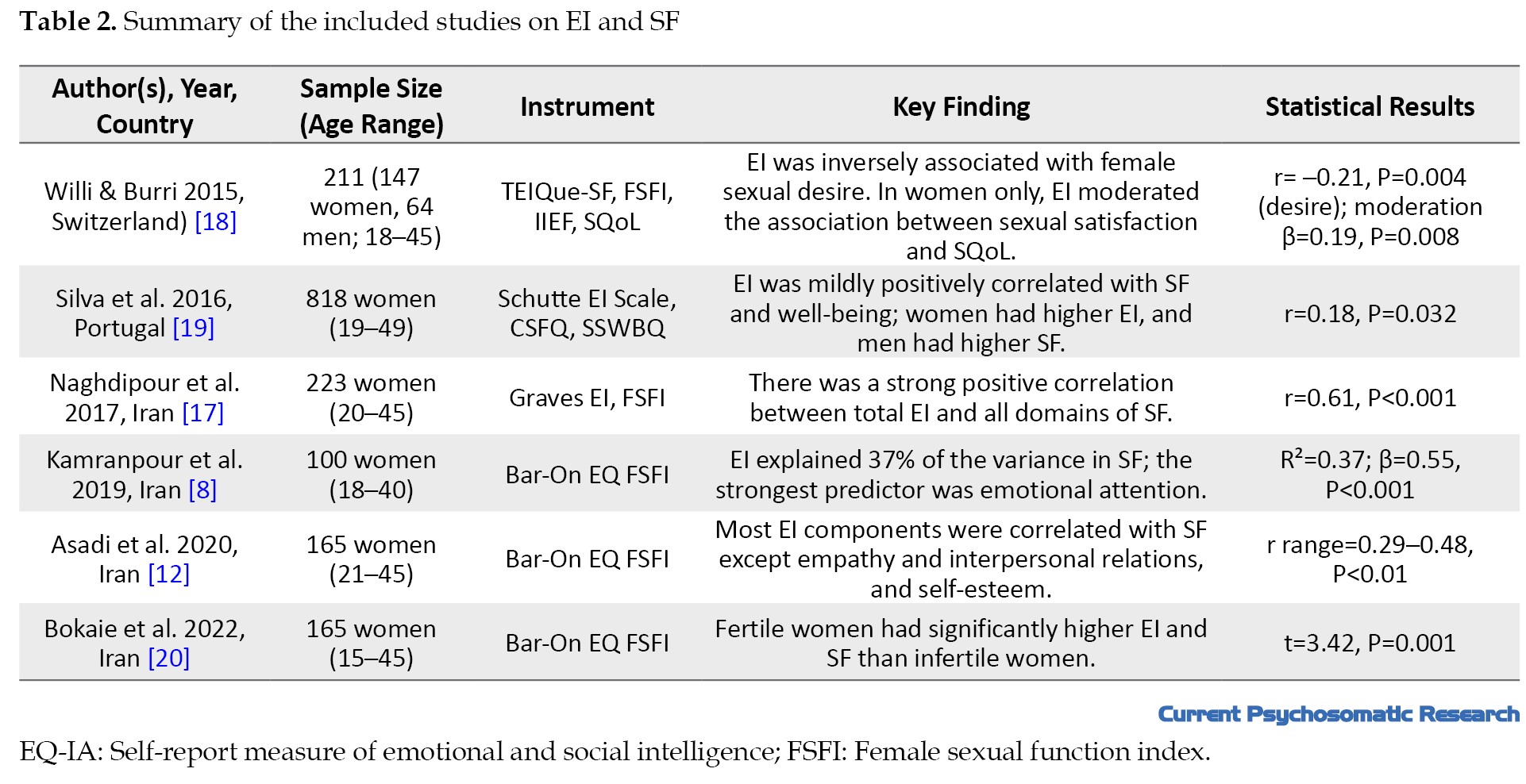
Five studies [8, 12, 17-19] consistently demonstrated a significant positive association between higher levels of EI and improved SF among women. Kamranpour et al. reported a strong positive correlation (r=0.60, P<0.05) between overall EI and female SF. Moreover, the components of emotional attention, emotional clarity, and emotional repair were identified as significant predictors of variance in SF [8].
Similarly, Asadi et al. found statistically significant correlations between most domains of EI and SF in women (r=0.32, P<0.001). However, no significant associations were observed for the dimensions of interpersonal relationships, responsibility, empathy, and self-esteem [12]. In another study conducted in 2017, EI was significantly correlated with overall SF as well as with each of its subdomains, confirming the multidimensional impact of EI on female sexual health [17].
Predictive components of emotional intelligence
Two studies employing stepwise regression analyses identified specific components of EI as significant predictors of SF [8, 19]. Notably, stress management, intrapersonal skills, general mood, and interpersonal relationships emerged as key variables. These components consistently demonstrated statistically significant predictive value for SF (r=0.23, P <0.05). Women with higher EI tended to exhibit better stress management, stronger intrapersonal skills, and more effective interpersonal relationships (P<0.05) [8, 19].
Willi and Burri highlighted notable gender-based differences in the relationship between EI and SF. Their findings revealed a negative correlation between EI and sexual desire in women (r=-0.21, P<0.01). Furthermore, EI was found to moderate the relationship between sexual satisfaction and sexual QoL among women, suggesting that EI may influence sexual well-being in complex ways that vary across genders and cultural contexts [18].
Silva et al. examined the link between EI and subjective sexual well-being, defined as the emotional and physical satisfaction derived from one’s sexual life. Their findings indicated a positive association between EI and subjective sexual well-being [19]. According to these studies, women with high EI are better able to manage their sexual relationships, supporting the hypothesis that EI plays a particularly important role in enhancing sexual satisfaction among women (Table 2) [17, 20].
Quality assessment
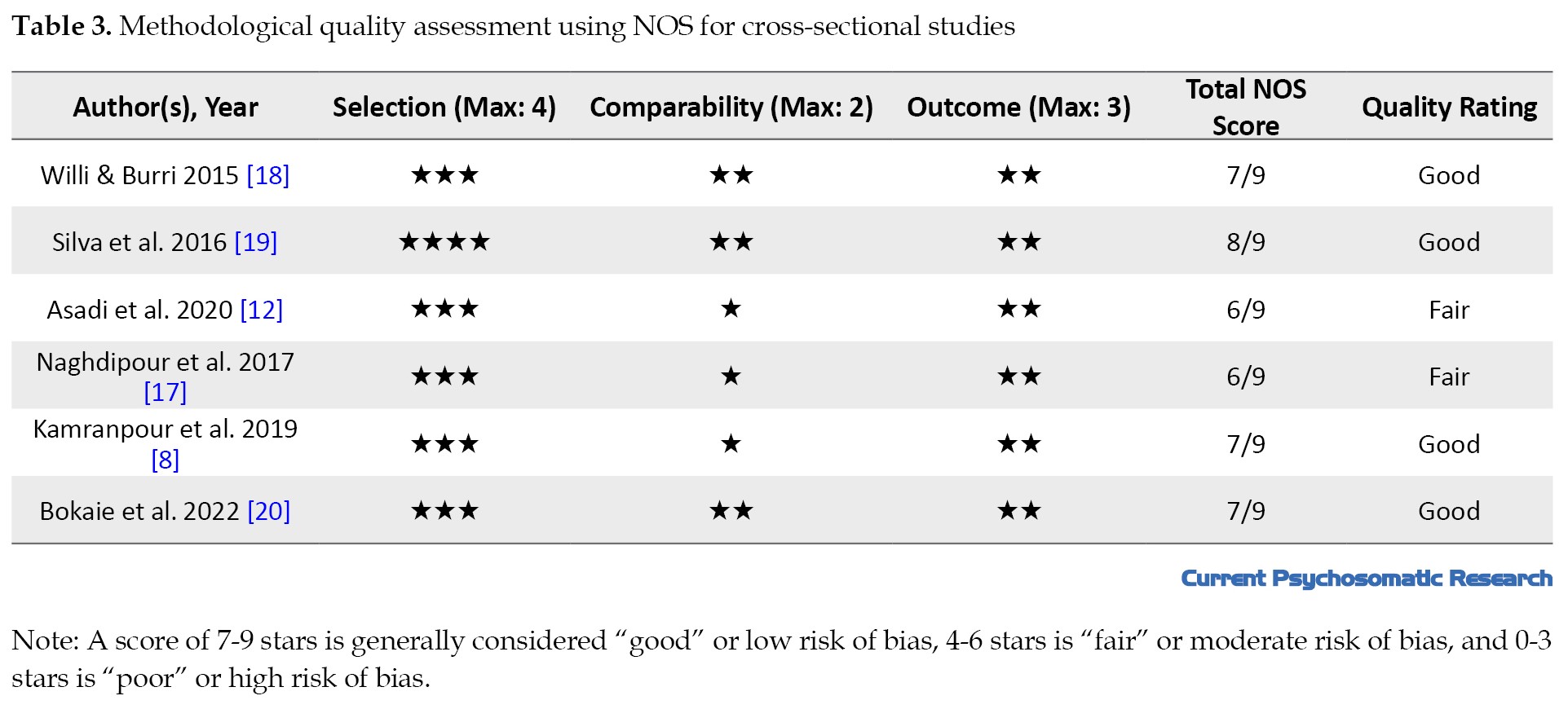
The methodological quality of the six included studies investigating the relationship between EI and SF was assessed using the NOS, adapted appropriately for both cross-sectional study designs. This evaluation focused on three key domains: Selection, comparability, and outcome. Among the reviewed studies, four received a score higher than 6 and were assessed as having a low risk of bias (rated as “good”) [12, 18-20]. Additionally, two studies received moderate scores [8, 17]. Detailed evaluations are presented in Table 3.
Discussion
The exclusion of relevant studies published in other languages may have been due to language publications. This language restriction may introduce selection bias and limit the generalizability of the findings across different cultural contexts.
The primary objective of this systematic review was to examine the relationship between EI and SF among reproductive-aged women. A total of six cross-sectional studies were included, each assessing different dimensions of EI in relation to sexual domains, such as desire, arousal, orgasm, satisfaction, and emotional intimacy. Overall, the findings support the notion that EI constitutes an important psychological factor influencing women’s sexual well-being. Higher levels of EI—particularly emotional awareness, self-regulation, empathy, and interpersonal competence—were consistently associated with better SF. These results align with psychological models that conceptualize emotional competence as a core prerequisite for intimacy, relational satisfaction, and adaptive sexual communication [19, 21-23].
However, an important and theoretically intriguing exception was observed in the study by Willi and Burri [18], which reported a negative association between EI and female sexual desire. This contradictory finding warrants careful interpretation rather than being dismissed as an anomaly. One possible explanation lies in the dual nature of EI. While EI facilitates emotional awareness and regulation, excessively high emotional monitoring may also increase self-consciousness, cognitive control, and performance-related anxiety. In this context, heightened emotional awareness may paradoxically inhibit spontaneous sexual desire by promoting over-analysis of emotional states, bodily sensations, or relational dynamics.
From a psychodynamic perspective, sexual desire is partly driven by automatic and affective processes, whereas high EI is associated with reflective and controlled emotional processing. Therefore, women with very high EI may rely more on cognitive regulation of emotions, which could suppress instinctive erotic impulses. This interpretation is consistent with models of sexual response that distinguish between inhibitory and excitatory systems, where increased cognitive control may activate sexual inhibition pathways and reduce desire.
Several included studies reported mixed or partially non-significant findings across specific dimensions of EI. For example, Asadi et al. [12] reported no significant association between empathy, interpersonal relations, and SF. These findings were retained in the synthesis to provide a balanced and comprehensive interpretation of the available evidence.
Moreover, Willi and Burri [18] suggested that EI may function as a moderator rather than a direct predictor of sexual outcomes. Their findings indicated that EI strengthened the relationship between sexual satisfaction and sexual QoL, even though it was negatively related to desire. This suggests that EI may improve the quality and meaning of sexual experiences, while not necessarily enhancing frequency or intensity of sexual desire [24]. In other words, emotionally intelligent women may experience fewer but more emotionally satisfying sexual encounters.
Cultural and methodological factors may also account for this inconsistency [25]. The Swiss sample used by Willi and Burri [18, 26] differed substantially from the Iranian and Portuguese samples included in other studies. Considering that four out of six studies were conducted in Iran and two studies in other countries, cultural differences may influence the outcomes. Therefore, the generalizability of these findings to other populations should be interpreted with caution, and future research should include culturally diverse samples. Cultural norms regarding sexuality, emotional expression, and gender roles may influence how EI manifests in sexual contexts [27]. Furthermore, most studies employed self-report instruments, which are susceptible to social desirability bias, particularly in cultures where sexual topics are sensitive.
Taken together, these findings indicate that the relationship between EI and SF is not strictly linear or uniformly positive. Instead, EI appears to exert a complex, multidimensional influence on SF. While EI generally enhances emotional intimacy, communication, and relational satisfaction [28, 29], very high levels of emotional regulation and self-monitoring may, under certain conditions, reduce sexual desire. This highlights the importance of conceptualizing EI not merely as a protective factor, but as a dynamic psychological construct whose effects depend on contextual, cultural, and intrapersonal variables.
Limitations
There are several limitations to this review that should be considered when interpreting the results. First, most of the included studies were conducted in Iran (four out of six); thus, he results may not be generalizable to other cultural contexts. Cultural norms regarding sexuality, gender roles, and emotional expression can vary widely, and these factors may influence both EI and SF. Therefore, the findings might reflect patterns specific to Iranian women rather than universally applicable trends. Second, all studies had cross-sectional designs, which prevents drawing causal conclusions. While associations between EI and SF were observed, it is not possible to determine the direction of these relationships or to rule out the influence of other unmeasured factors.
Third, the reliance on self-report measures introduces potential biases. Given the sensitive nature of sexual topics, responses may be affected by social desirability or recall bias, which could influence the observed associations. Fourth, methodological differences across studies—such as the use of different questionnaires, outcome measures, and statistical approaches—make it difficult to directly compare results or perform a meta-analysis.
Finally, some important participant characteristics, including age, relationship duration, marital quality, and psychological factors, were not consistently reported or controlled. Future research should aim to include culturally diverse samples and consider these moderating variables to better understand the relationship between EI and SF across different contexts.
Conclusion
Overall, the evidence synthesized in this review suggests that EI is generally associated with aspects of SF among reproductive-aged women, although the strength and direction of this relationship vary across studies. While several studies reported moderate to strong positive associations between EI and domains, such as sexual satisfaction, arousal, and relational intimacy, other findings indicate weak, non-significant, or even negative relationships for certain EI components, particularly sexual desire.
These inconsistencies suggest that the relationship between EI and SF is complex and context-dependent rather than uniformly positive. Cultural context, measurement tools, and specific EI dimensions may substantially influence observed outcomes. Future longitudinal and culturally diverse studies are needed to clarify causal pathways and determine whether EI-based interventions can effectively improve women’s sexual well-being.
Ethical Considerations
Compliance with ethical guidelines
The study was a systematic review of previously published studies and did not collect new data from human participants. Therefore, formal ethical approval and direct informed consent were not required for the present review. The review adhered to research integrity standards. The study protocol was registered in the PROSPERO database (CRD420251082825), ensuring methodological transparency and adherence to systematic review standards. All data were extracted from published sources, and the ethical approvals and informed consent procedures reported in the original studies were respected where applicable.
Funding
This research did not receive any grant from funding agencies in the public, commercial, or non-profit sectors.
Authors' contributions
All authors contributed equally to the conception and design of the study, data collection and analysis, interpretation of the results, and drafting of the manuscript. Each author approved the final version of the manuscript for submission.
Conflict of interest
The authors declared no conflict of interest.
Full-Text: (39 Views)
Introduction
Sexual function (SF) constitutes a core component of women’s biopsychosocial health and is closely associated with overall quality of life (QoL) [1]. This multidimensional construct includes sexual desire, arousal, lubrication, orgasm, satisfaction, and pain, and is shaped by an intricate interaction of biological, psychological, relational, cultural, and emotional factors [2]. Impairments in SF not only reduce sexual satisfaction but also adversely affect emotional well-being, interpersonal relationships, and life satisfaction [3]. Epidemiological evidence indicates that female sexual dysfunction (FSD) is highly prevalent, with global estimates ranging from 25.8% to 67%, and meta-analytic findings across different countries reporting prevalence rates between 28% and 41% [4, 5]. FSD is commonly classified into three major categories: sexual interest/arousal disorder, orgasmic disorder, and genito-pelvic pain/penetration disorder [4].
The etiology of sexual dysfunction is multifactorial. Biological determinants include chronic diseases (e.g. diabetes, cardiovascular disorders), hormonal changes, gynecological conditions, reproductive events (e.g. pregnancy, childbirth, menopause), and neurological or pharmacological factors [5, 6]. Simultaneously, psychological and interpersonal variables, such as stress, anxiety, depression, low self-esteem, body image dissatisfaction, past traumatic experiences, partner-related factors, and relationship dynamics play a critical role in shaping women’s sexual experiences [7]. These findings highlight that SF cannot be fully explained by physiological mechanisms alone, and must be understood within a broader emotional and relational context.
In this regard, emotional intelligence (EI) has been proposed as a key psychological construct that may influence SF through its effects on emotional awareness, regulation, empathy, and interpersonal communication. EI is generally defined as the capacity to perceive, understand, manage, and utilize emotions in oneself and others in order to facilitate adaptive functioning and personal growth [8–10]. Theoretically, women with higher EI may be better able to regulate anxiety, express sexual needs, manage relational conflicts, and establish emotional intimacy, all of which are central to healthy SF.
Empirical studies examining the relationship between EI and SF have yielded inconsistent findings. While several studies report a positive association between EI and dimensions of women’s SF, such as desire, arousal, and satisfaction [11, 12], other investigations have found weak, null, or even negative relationships between certain EI components and sexual desire [13, 14]. Moreover, most studies have relied on cross-sectional designs and have lacked a coherent theoretical framework linking specific EI dimensions (e.g. emotional clarity, emotion regulation, empathy) to particular domains of SF.
Given the high prevalence of FSD and its significant impact on women’s well-being and marital satisfaction, there is a clear need for an integrated and theory-driven synthesis of existing evidence. Specifically, understanding how emotional competencies relate to sexual health may provide valuable insights for psychological and educational interventions aimed at improving intimate relationships. Therefore, the present systematic review was conducted to critically examine and synthesize the available literature on the relationship between EI and SF among reproductive-aged women.
Materials and methods
Study design
This study was performed as a systematic review following the preferred reporting items for systematic reviews and meta-analyses (PRISMA2020) guidelines. The PRISMA 2020 checklist and flow diagram are provided as supplementary materials. The search strategy was tailored to the indexing structure of each database, and reference lists of the included studies were manually screened to ensure comprehensive coverage. The protocol for this study was registered in the PROSPERO database with the registration number (CRD420251082825). No restrictions or exclusions were based on statistical significance. All studies meeting the inclusion criteria were included regardless of whether their results were statistically significant or non-significant. No criterion regarding statistical significance was specified in the original PROSPERO protocol; therefore, no post-registration changes were made in this regard. The authors confirm that all procedures conducted in this review strictly follow the protocol registered in PROSPERO with no modifications made after registration.”
Following study selection, a structured data extraction form was used to systematically collect key information, including study design, sample characteristics, EI measurement tools, SF domains, and reported effect sizes. A thematic synthesis approach was then applied to integrate the findings. Specifically, results were coded based on conceptual domains of EI (e.g. emotional awareness, emotion regulation, empathy, and social skills) and mapped onto corresponding dimensions of SF (e.g. desire, arousal, satisfaction, and orgasm).
The thematic synthesis followed a structured multistage process.
First, all extracted findings describing associations between EI and SF were coded linebyline. This initial stage generated 23 preliminary codes, representing different EI components (e.g. emotional awareness, stress management, empathy, and interpersonal skills) and SF domains (e.g. desire, arousal, satisfaction, and orgasm).
Second, related codes were grouped into seven descriptive themes, including emotional regulation, emotional awareness, interpersonal competence, stress management, sexual desire, sexual satisfaction, and overall SF.
Third, these descriptive themes were further synthesized into three higherorder analytical themes:
Emotional regulation and intrapersonal competence as facilitators of Sf; interpersonal emotional skills and relationship satisfaction in sexual wellbeing; complex and sometimes contradictory associations between emotional awareness and sexual desire.
The coding and synthesis were conducted manually due to the limited number of included studies. Two reviewers independently reviewed the coding structure and thematic grouping, and discrepancies were resolved through discussion until consensus was achieved.
A quantitative meta-analysis was considered inappropriate due to substantial methodological heterogeneity among the included studies. Specifically, studies differed considerably in terms of:
1) EI measurement tools (e.g., BarOn EQi, Schutte EI Scale, Graves EI Scale, TEIQueSF), 2) SF instruments (e.g. FSFI, CSFQ), 3) Statistical reporting formats (correlations, regression coefficients, moderation analyses), 4) Population characteristics and sampling strategies.
A preliminary assessment of statistical heterogeneity based on the reported correlation coefficients suggested substantial variability between studies (estimated I²>70%), indicating high heterogeneity in effect sizes. Because many studies did not report sufficient statistical parameters (e.g. standard errors or confidence intervals) required for standardized effect size pooling, reliable quantitative synthesis was not feasible.
Therefore, a narrative and thematic synthesis approach was adopted to interpret patterns of association across studies rather than producing a potentially misleading pooled estimate.
Search strategy
A thorough and systematic search was conducted across Google Scholar and several major electronic databases, including PubMed, Web of Science, Scopus, and ScienceDirect, in order to identify relevant studies examining the relationship between EI and SF. The systematic literature search was conducted from database inception until 19 August 2025. The final search update was performed on 31 August 2025 to ensure inclusion of the most recent and relevant studies.
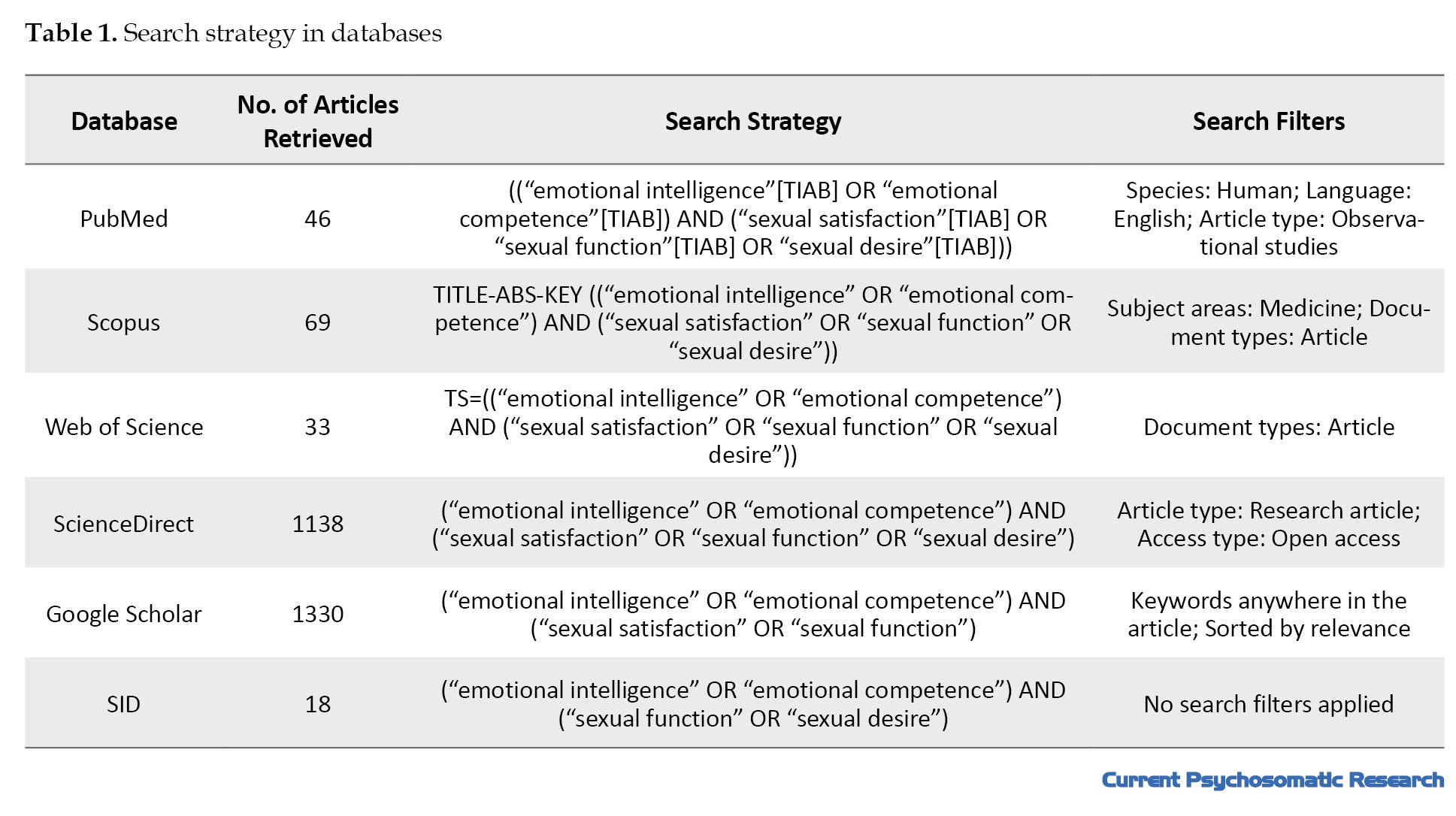
All relevant studies published up to the year 2025 were considered, without any lower time limit. The search strategy employed a combination of English keywords, tailored to the advanced search functions of each database. All stages of study selection and exclusion were conducted according to PRISMA 2020 guidelines. In PubMed, medical subject headings (MeSH) were utilized, including terms, such as “emotional intelligence,” “sexual satisfaction,” and “sexual function,” and “sexual desire.” Comparable strategies were implemented across the other platforms, incorporating Boolean operators (AND, OR) to enhance search sensitivity and specificity (Table 1).
Furthermore, to identify additional eligible studies not captured by the electronic search, we manually reviewed the reference lists of all included articles.
Google Scholar was used only as a supplementary source for grey literature and citation tracking, rather than as a primary database, because of its limited search precision and lack of advanced filtering capabilities. The screening of Google Scholar results was restricted to the first 200 results sorted by relevance, which is a commonly recommended approach in systematic reviews.
Inclusion and exclusion criteria
The included studies were observational in nature, including cross-sectional and case–control designs. Eligible studies were those that examined the association between EI and SF using validated measurement tools. No statistical significance filter was applied during the literature search, screening, or study selection process. Studies were included regardless of whether the reported associations were statistically significant or non-significant, in order to minimize selection bias and ensure comprehensive evidence synthesis.
Studies were excluded if they were case reports, case series, narrative or systematic reviews, editorials, letters to the editor, conference abstracts, or randomized controlled trials. In addition, studies were excluded if they did not directly examine the relationship between EI and SF, or if full texts were unavailable. All included studies were verified to cover the specified time frames and datasets mentioned in this review. No studies were omitted, ensuring the comprehensiveness of the data synthesis.
Data extraction
Four stages of study selection involved: (1) removal of duplicates, (2) screening of titles and abstracts, (3) full-text assessment based on predefined inclusion and exclusion criteria, and (4) final inclusion of eligible articles. Two independent reviewers (Faezeh Heydari and Diana Azizi) conducted the screening and selection processes. Any disagreements were resolved through discussion, or by consulting a third reviewer (Soghra Khani), when necessary. A standard data extraction form was used to extract data from the selected studies. The extracted information included the authors’ names, year of publication, country of origin, instruments used to assess EI and SF, and the main findings of each study.
Quality assessment
To assess the methodological quality of the included studies, the Newcastle-Ottawa scale (NOS) for cross-sectional studies was applied. For cohort studies, scores of 3–4 in selection, 1–2 in comparability, and 2–3 in outcome domains were considered indicative of high quality. Cross-sectional studies were assessed using a scoring system with a maximum score of 9; studies scoring below 5 were considered low quality [15, 16]. Most of the included studies were rated as moderate to high quality, supporting the reliability of the findings.
Results
Results of search and selection strategy
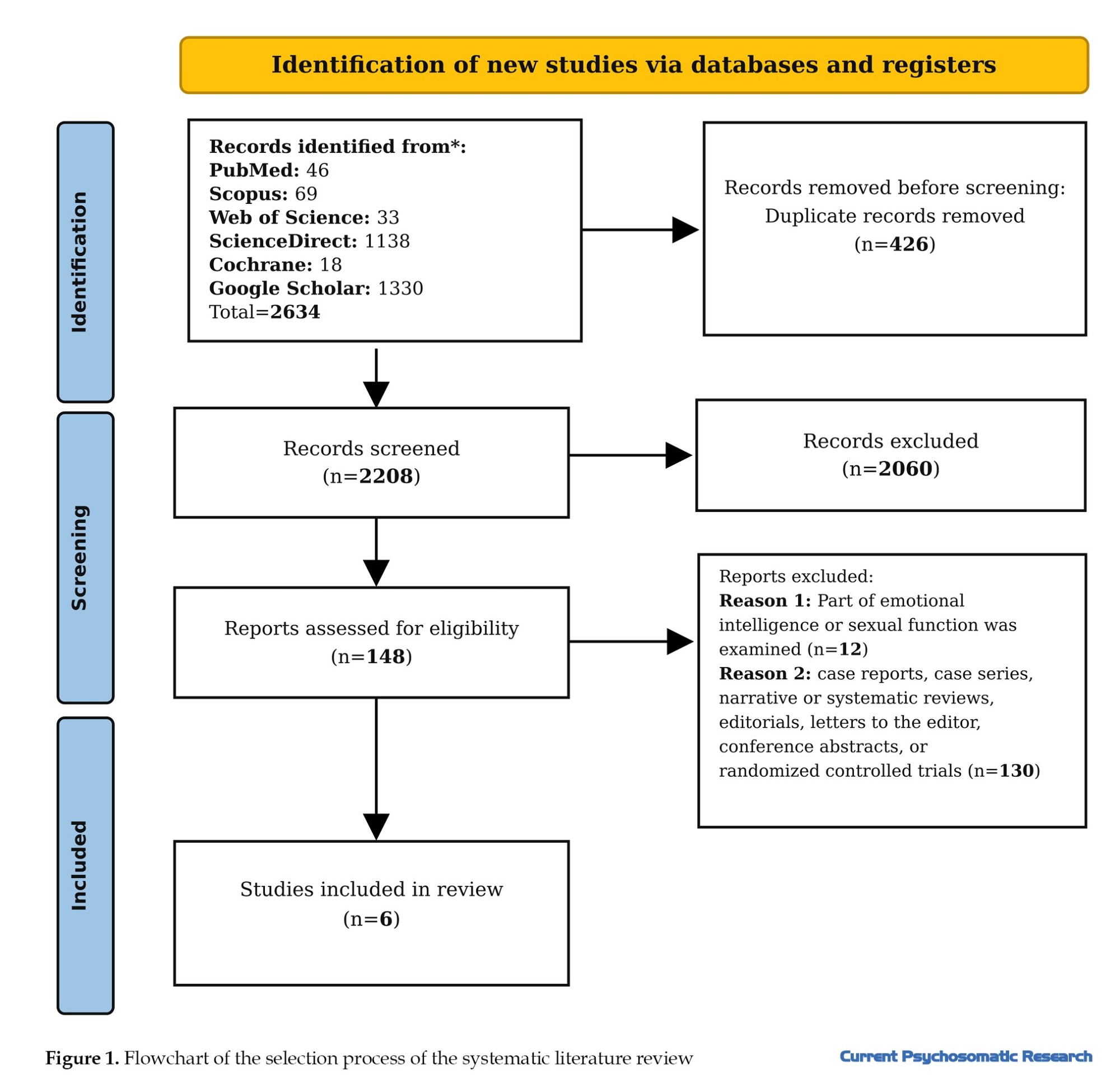
The initial database search yielded 2,634 records. After removing 426 duplicate records, 2,208 titles and abstracts were screened. Of these, 2,060 studies were excluded due to irrelevance to the study objective or insufficient data. Subsequently, the full texts of 148 articles were assessed for eligibility. Among these, 142 studies were excluded for the following reasons: evaluation of only a component of EI or SF rather than the primary variables of interest (n=12), inappropriate study design including case reports, case series, reviews, editorials, letters to the editor, and conference abstracts (n=94), insufficient statistical or outcome data (n=21), and lack of female-specific data or inconsistency with the study objectives (n=15). In the end, six studies met the inclusion criteria and were included in the final review (Figure 1).
Sexual function (SF) constitutes a core component of women’s biopsychosocial health and is closely associated with overall quality of life (QoL) [1]. This multidimensional construct includes sexual desire, arousal, lubrication, orgasm, satisfaction, and pain, and is shaped by an intricate interaction of biological, psychological, relational, cultural, and emotional factors [2]. Impairments in SF not only reduce sexual satisfaction but also adversely affect emotional well-being, interpersonal relationships, and life satisfaction [3]. Epidemiological evidence indicates that female sexual dysfunction (FSD) is highly prevalent, with global estimates ranging from 25.8% to 67%, and meta-analytic findings across different countries reporting prevalence rates between 28% and 41% [4, 5]. FSD is commonly classified into three major categories: sexual interest/arousal disorder, orgasmic disorder, and genito-pelvic pain/penetration disorder [4].
The etiology of sexual dysfunction is multifactorial. Biological determinants include chronic diseases (e.g. diabetes, cardiovascular disorders), hormonal changes, gynecological conditions, reproductive events (e.g. pregnancy, childbirth, menopause), and neurological or pharmacological factors [5, 6]. Simultaneously, psychological and interpersonal variables, such as stress, anxiety, depression, low self-esteem, body image dissatisfaction, past traumatic experiences, partner-related factors, and relationship dynamics play a critical role in shaping women’s sexual experiences [7]. These findings highlight that SF cannot be fully explained by physiological mechanisms alone, and must be understood within a broader emotional and relational context.
In this regard, emotional intelligence (EI) has been proposed as a key psychological construct that may influence SF through its effects on emotional awareness, regulation, empathy, and interpersonal communication. EI is generally defined as the capacity to perceive, understand, manage, and utilize emotions in oneself and others in order to facilitate adaptive functioning and personal growth [8–10]. Theoretically, women with higher EI may be better able to regulate anxiety, express sexual needs, manage relational conflicts, and establish emotional intimacy, all of which are central to healthy SF.
Empirical studies examining the relationship between EI and SF have yielded inconsistent findings. While several studies report a positive association between EI and dimensions of women’s SF, such as desire, arousal, and satisfaction [11, 12], other investigations have found weak, null, or even negative relationships between certain EI components and sexual desire [13, 14]. Moreover, most studies have relied on cross-sectional designs and have lacked a coherent theoretical framework linking specific EI dimensions (e.g. emotional clarity, emotion regulation, empathy) to particular domains of SF.
Given the high prevalence of FSD and its significant impact on women’s well-being and marital satisfaction, there is a clear need for an integrated and theory-driven synthesis of existing evidence. Specifically, understanding how emotional competencies relate to sexual health may provide valuable insights for psychological and educational interventions aimed at improving intimate relationships. Therefore, the present systematic review was conducted to critically examine and synthesize the available literature on the relationship between EI and SF among reproductive-aged women.
Materials and methods
Study design
This study was performed as a systematic review following the preferred reporting items for systematic reviews and meta-analyses (PRISMA2020) guidelines. The PRISMA 2020 checklist and flow diagram are provided as supplementary materials. The search strategy was tailored to the indexing structure of each database, and reference lists of the included studies were manually screened to ensure comprehensive coverage. The protocol for this study was registered in the PROSPERO database with the registration number (CRD420251082825). No restrictions or exclusions were based on statistical significance. All studies meeting the inclusion criteria were included regardless of whether their results were statistically significant or non-significant. No criterion regarding statistical significance was specified in the original PROSPERO protocol; therefore, no post-registration changes were made in this regard. The authors confirm that all procedures conducted in this review strictly follow the protocol registered in PROSPERO with no modifications made after registration.”
Following study selection, a structured data extraction form was used to systematically collect key information, including study design, sample characteristics, EI measurement tools, SF domains, and reported effect sizes. A thematic synthesis approach was then applied to integrate the findings. Specifically, results were coded based on conceptual domains of EI (e.g. emotional awareness, emotion regulation, empathy, and social skills) and mapped onto corresponding dimensions of SF (e.g. desire, arousal, satisfaction, and orgasm).
The thematic synthesis followed a structured multistage process.
First, all extracted findings describing associations between EI and SF were coded linebyline. This initial stage generated 23 preliminary codes, representing different EI components (e.g. emotional awareness, stress management, empathy, and interpersonal skills) and SF domains (e.g. desire, arousal, satisfaction, and orgasm).
Second, related codes were grouped into seven descriptive themes, including emotional regulation, emotional awareness, interpersonal competence, stress management, sexual desire, sexual satisfaction, and overall SF.
Third, these descriptive themes were further synthesized into three higherorder analytical themes:
Emotional regulation and intrapersonal competence as facilitators of Sf; interpersonal emotional skills and relationship satisfaction in sexual wellbeing; complex and sometimes contradictory associations between emotional awareness and sexual desire.
The coding and synthesis were conducted manually due to the limited number of included studies. Two reviewers independently reviewed the coding structure and thematic grouping, and discrepancies were resolved through discussion until consensus was achieved.
A quantitative meta-analysis was considered inappropriate due to substantial methodological heterogeneity among the included studies. Specifically, studies differed considerably in terms of:
1) EI measurement tools (e.g., BarOn EQi, Schutte EI Scale, Graves EI Scale, TEIQueSF), 2) SF instruments (e.g. FSFI, CSFQ), 3) Statistical reporting formats (correlations, regression coefficients, moderation analyses), 4) Population characteristics and sampling strategies.
A preliminary assessment of statistical heterogeneity based on the reported correlation coefficients suggested substantial variability between studies (estimated I²>70%), indicating high heterogeneity in effect sizes. Because many studies did not report sufficient statistical parameters (e.g. standard errors or confidence intervals) required for standardized effect size pooling, reliable quantitative synthesis was not feasible.
Therefore, a narrative and thematic synthesis approach was adopted to interpret patterns of association across studies rather than producing a potentially misleading pooled estimate.
Search strategy
A thorough and systematic search was conducted across Google Scholar and several major electronic databases, including PubMed, Web of Science, Scopus, and ScienceDirect, in order to identify relevant studies examining the relationship between EI and SF. The systematic literature search was conducted from database inception until 19 August 2025. The final search update was performed on 31 August 2025 to ensure inclusion of the most recent and relevant studies.
All relevant studies published up to the year 2025 were considered, without any lower time limit. The search strategy employed a combination of English keywords, tailored to the advanced search functions of each database. All stages of study selection and exclusion were conducted according to PRISMA 2020 guidelines. In PubMed, medical subject headings (MeSH) were utilized, including terms, such as “emotional intelligence,” “sexual satisfaction,” and “sexual function,” and “sexual desire.” Comparable strategies were implemented across the other platforms, incorporating Boolean operators (AND, OR) to enhance search sensitivity and specificity (Table 1).
Furthermore, to identify additional eligible studies not captured by the electronic search, we manually reviewed the reference lists of all included articles.
Google Scholar was used only as a supplementary source for grey literature and citation tracking, rather than as a primary database, because of its limited search precision and lack of advanced filtering capabilities. The screening of Google Scholar results was restricted to the first 200 results sorted by relevance, which is a commonly recommended approach in systematic reviews.
Inclusion and exclusion criteria
The included studies were observational in nature, including cross-sectional and case–control designs. Eligible studies were those that examined the association between EI and SF using validated measurement tools. No statistical significance filter was applied during the literature search, screening, or study selection process. Studies were included regardless of whether the reported associations were statistically significant or non-significant, in order to minimize selection bias and ensure comprehensive evidence synthesis.
Studies were excluded if they were case reports, case series, narrative or systematic reviews, editorials, letters to the editor, conference abstracts, or randomized controlled trials. In addition, studies were excluded if they did not directly examine the relationship between EI and SF, or if full texts were unavailable. All included studies were verified to cover the specified time frames and datasets mentioned in this review. No studies were omitted, ensuring the comprehensiveness of the data synthesis.
Data extraction
Four stages of study selection involved: (1) removal of duplicates, (2) screening of titles and abstracts, (3) full-text assessment based on predefined inclusion and exclusion criteria, and (4) final inclusion of eligible articles. Two independent reviewers (Faezeh Heydari and Diana Azizi) conducted the screening and selection processes. Any disagreements were resolved through discussion, or by consulting a third reviewer (Soghra Khani), when necessary. A standard data extraction form was used to extract data from the selected studies. The extracted information included the authors’ names, year of publication, country of origin, instruments used to assess EI and SF, and the main findings of each study.
Quality assessment
To assess the methodological quality of the included studies, the Newcastle-Ottawa scale (NOS) for cross-sectional studies was applied. For cohort studies, scores of 3–4 in selection, 1–2 in comparability, and 2–3 in outcome domains were considered indicative of high quality. Cross-sectional studies were assessed using a scoring system with a maximum score of 9; studies scoring below 5 were considered low quality [15, 16]. Most of the included studies were rated as moderate to high quality, supporting the reliability of the findings.
Results
Results of search and selection strategy
The initial database search yielded 2,634 records. After removing 426 duplicate records, 2,208 titles and abstracts were screened. Of these, 2,060 studies were excluded due to irrelevance to the study objective or insufficient data. Subsequently, the full texts of 148 articles were assessed for eligibility. Among these, 142 studies were excluded for the following reasons: evaluation of only a component of EI or SF rather than the primary variables of interest (n=12), inappropriate study design including case reports, case series, reviews, editorials, letters to the editor, and conference abstracts (n=94), insufficient statistical or outcome data (n=21), and lack of female-specific data or inconsistency with the study objectives (n=15). In the end, six studies met the inclusion criteria and were included in the final review (Figure 1).
Associations between emotional intelligence and sexual function
Five studies [8, 12, 17-19] consistently demonstrated a significant positive association between higher levels of EI and improved SF among women. Kamranpour et al. reported a strong positive correlation (r=0.60, P<0.05) between overall EI and female SF. Moreover, the components of emotional attention, emotional clarity, and emotional repair were identified as significant predictors of variance in SF [8].
Similarly, Asadi et al. found statistically significant correlations between most domains of EI and SF in women (r=0.32, P<0.001). However, no significant associations were observed for the dimensions of interpersonal relationships, responsibility, empathy, and self-esteem [12]. In another study conducted in 2017, EI was significantly correlated with overall SF as well as with each of its subdomains, confirming the multidimensional impact of EI on female sexual health [17].
Predictive components of emotional intelligence
Two studies employing stepwise regression analyses identified specific components of EI as significant predictors of SF [8, 19]. Notably, stress management, intrapersonal skills, general mood, and interpersonal relationships emerged as key variables. These components consistently demonstrated statistically significant predictive value for SF (r=0.23, P <0.05). Women with higher EI tended to exhibit better stress management, stronger intrapersonal skills, and more effective interpersonal relationships (P<0.05) [8, 19].
Willi and Burri highlighted notable gender-based differences in the relationship between EI and SF. Their findings revealed a negative correlation between EI and sexual desire in women (r=-0.21, P<0.01). Furthermore, EI was found to moderate the relationship between sexual satisfaction and sexual QoL among women, suggesting that EI may influence sexual well-being in complex ways that vary across genders and cultural contexts [18].
Silva et al. examined the link between EI and subjective sexual well-being, defined as the emotional and physical satisfaction derived from one’s sexual life. Their findings indicated a positive association between EI and subjective sexual well-being [19]. According to these studies, women with high EI are better able to manage their sexual relationships, supporting the hypothesis that EI plays a particularly important role in enhancing sexual satisfaction among women (Table 2) [17, 20].
Quality assessment
The methodological quality of the six included studies investigating the relationship between EI and SF was assessed using the NOS, adapted appropriately for both cross-sectional study designs. This evaluation focused on three key domains: Selection, comparability, and outcome. Among the reviewed studies, four received a score higher than 6 and were assessed as having a low risk of bias (rated as “good”) [12, 18-20]. Additionally, two studies received moderate scores [8, 17]. Detailed evaluations are presented in Table 3.
Discussion
The exclusion of relevant studies published in other languages may have been due to language publications. This language restriction may introduce selection bias and limit the generalizability of the findings across different cultural contexts.
The primary objective of this systematic review was to examine the relationship between EI and SF among reproductive-aged women. A total of six cross-sectional studies were included, each assessing different dimensions of EI in relation to sexual domains, such as desire, arousal, orgasm, satisfaction, and emotional intimacy. Overall, the findings support the notion that EI constitutes an important psychological factor influencing women’s sexual well-being. Higher levels of EI—particularly emotional awareness, self-regulation, empathy, and interpersonal competence—were consistently associated with better SF. These results align with psychological models that conceptualize emotional competence as a core prerequisite for intimacy, relational satisfaction, and adaptive sexual communication [19, 21-23].
However, an important and theoretically intriguing exception was observed in the study by Willi and Burri [18], which reported a negative association between EI and female sexual desire. This contradictory finding warrants careful interpretation rather than being dismissed as an anomaly. One possible explanation lies in the dual nature of EI. While EI facilitates emotional awareness and regulation, excessively high emotional monitoring may also increase self-consciousness, cognitive control, and performance-related anxiety. In this context, heightened emotional awareness may paradoxically inhibit spontaneous sexual desire by promoting over-analysis of emotional states, bodily sensations, or relational dynamics.
From a psychodynamic perspective, sexual desire is partly driven by automatic and affective processes, whereas high EI is associated with reflective and controlled emotional processing. Therefore, women with very high EI may rely more on cognitive regulation of emotions, which could suppress instinctive erotic impulses. This interpretation is consistent with models of sexual response that distinguish between inhibitory and excitatory systems, where increased cognitive control may activate sexual inhibition pathways and reduce desire.
Several included studies reported mixed or partially non-significant findings across specific dimensions of EI. For example, Asadi et al. [12] reported no significant association between empathy, interpersonal relations, and SF. These findings were retained in the synthesis to provide a balanced and comprehensive interpretation of the available evidence.
Moreover, Willi and Burri [18] suggested that EI may function as a moderator rather than a direct predictor of sexual outcomes. Their findings indicated that EI strengthened the relationship between sexual satisfaction and sexual QoL, even though it was negatively related to desire. This suggests that EI may improve the quality and meaning of sexual experiences, while not necessarily enhancing frequency or intensity of sexual desire [24]. In other words, emotionally intelligent women may experience fewer but more emotionally satisfying sexual encounters.
Cultural and methodological factors may also account for this inconsistency [25]. The Swiss sample used by Willi and Burri [18, 26] differed substantially from the Iranian and Portuguese samples included in other studies. Considering that four out of six studies were conducted in Iran and two studies in other countries, cultural differences may influence the outcomes. Therefore, the generalizability of these findings to other populations should be interpreted with caution, and future research should include culturally diverse samples. Cultural norms regarding sexuality, emotional expression, and gender roles may influence how EI manifests in sexual contexts [27]. Furthermore, most studies employed self-report instruments, which are susceptible to social desirability bias, particularly in cultures where sexual topics are sensitive.
Taken together, these findings indicate that the relationship between EI and SF is not strictly linear or uniformly positive. Instead, EI appears to exert a complex, multidimensional influence on SF. While EI generally enhances emotional intimacy, communication, and relational satisfaction [28, 29], very high levels of emotional regulation and self-monitoring may, under certain conditions, reduce sexual desire. This highlights the importance of conceptualizing EI not merely as a protective factor, but as a dynamic psychological construct whose effects depend on contextual, cultural, and intrapersonal variables.
Limitations
There are several limitations to this review that should be considered when interpreting the results. First, most of the included studies were conducted in Iran (four out of six); thus, he results may not be generalizable to other cultural contexts. Cultural norms regarding sexuality, gender roles, and emotional expression can vary widely, and these factors may influence both EI and SF. Therefore, the findings might reflect patterns specific to Iranian women rather than universally applicable trends. Second, all studies had cross-sectional designs, which prevents drawing causal conclusions. While associations between EI and SF were observed, it is not possible to determine the direction of these relationships or to rule out the influence of other unmeasured factors.
Third, the reliance on self-report measures introduces potential biases. Given the sensitive nature of sexual topics, responses may be affected by social desirability or recall bias, which could influence the observed associations. Fourth, methodological differences across studies—such as the use of different questionnaires, outcome measures, and statistical approaches—make it difficult to directly compare results or perform a meta-analysis.
Finally, some important participant characteristics, including age, relationship duration, marital quality, and psychological factors, were not consistently reported or controlled. Future research should aim to include culturally diverse samples and consider these moderating variables to better understand the relationship between EI and SF across different contexts.
Conclusion
Overall, the evidence synthesized in this review suggests that EI is generally associated with aspects of SF among reproductive-aged women, although the strength and direction of this relationship vary across studies. While several studies reported moderate to strong positive associations between EI and domains, such as sexual satisfaction, arousal, and relational intimacy, other findings indicate weak, non-significant, or even negative relationships for certain EI components, particularly sexual desire.
These inconsistencies suggest that the relationship between EI and SF is complex and context-dependent rather than uniformly positive. Cultural context, measurement tools, and specific EI dimensions may substantially influence observed outcomes. Future longitudinal and culturally diverse studies are needed to clarify causal pathways and determine whether EI-based interventions can effectively improve women’s sexual well-being.
Ethical Considerations
Compliance with ethical guidelines
The study was a systematic review of previously published studies and did not collect new data from human participants. Therefore, formal ethical approval and direct informed consent were not required for the present review. The review adhered to research integrity standards. The study protocol was registered in the PROSPERO database (CRD420251082825), ensuring methodological transparency and adherence to systematic review standards. All data were extracted from published sources, and the ethical approvals and informed consent procedures reported in the original studies were respected where applicable.
Funding
This research did not receive any grant from funding agencies in the public, commercial, or non-profit sectors.
Authors' contributions
All authors contributed equally to the conception and design of the study, data collection and analysis, interpretation of the results, and drafting of the manuscript. Each author approved the final version of the manuscript for submission.
Conflict of interest
The authors declared no conflict of interest.
References
- Oindi FM, Murage A, Lema VM, Mukaindo AM. Association of female sexual dysfunction and fertility: A cross sectional study. Fertil Res Pract. 2019; 5:12. [DOI:10.1186/s40738-019-0065-9] [PMID]
- Valadares ALR, Costa-Paiva L. Female and male factors associated with female sexual function in couples aged 50-70 years: A cross-sectional study. Menopause. 2025; 32(9):838-48. [DOI:10.1097/GME.0000000000002405] [PMID]
- Torkamani A, Jamshidimanesh M, Pezaro S, Amirkhalili E. Examining the effect of a sexual self-efficacy based educational intervention on postmenopausal sexual satisfaction and sexual distress: A parallel quasi-experimental study. BMC Womens Health. 2025; 25(1):302. [DOI:10.1186/s12905-025-03851-8] [PMID]
- McCool-Myers M, Theurich M, Zuelke A, Knuettel H, Apfelbacher C. Predictors of female sexual dysfunction: a systematic review and qualitative analysis through gender inequality paradigms. BMC Womens Health. 2018; 18(1):108. [DOI:10.1186/s12905-018-0523-4] [PMID] [PMCID]
- McCool ME, Zuelke A, Theurich MA, Knuettel H, Ricci C, Apfelbacher C. Prevalence of female sexual dysfunction among premenopausal women: A systematic review and meta-analysis of observational studies. Sex Med Rev. 2016; 4(3):197-212. [DOI:10.1016/j.sxmr.2016.03.002]
- Alidost F, Pakzad R, Dolatian M, Abdi F. Sexual dysfunction among women of reproductive age: A systematic review and meta-analysis. Int J Reprod Biomed. 2021; 19(5):421-32. [DOI:10.18502/ijrm.v19i5.9310] [PMID] [PMCID]
- Asefa A, Nigussie T, Henok A, Mamo Y. Prevalence of sexual dysfunction and related factors among diabetes mellitus patients in Southwest Ethiopia. BMC Endocr Disord. 2019; 19(1):141. [DOI:10.1186/s12902-019-0367-6] [PMID] [PMCID]
- Kamranpour SB, Tarahi MJ, Kohan S, Alizadeh S. Relationship of emotional intelligence with sexual function in females. J Holist Nurs Midwifery. 2019; 29(2):65-72. [DOI:10.32598/jhnm.29.2.65]
- Amin SM, El-Gazar HE, Zoromba MA, ELfeshawy NI, Abo-Hatab TAE, El-Sherbini HH, et al. The mediating role of emotional intelligence in the relationship between sexual health literacy and sexual communication self-efficacy among married nursing students. BMC Nurs. 2025; 24(1):653. [DOI:10.1186/s12912-025-0653-7] [PMID] [PMCID]
- Mokhtari F, Kamranpour B, Shakiba M. Emotional intelligence and men’s sexual performance. J Holist Nurs Midwifery. 2020; 30(3):174-81. [DOI:10.32598/jhnm.30.3.174]
- Milani AS, Hosseini M, Matbouei M, Nasiri M. Effectiveness of emotional intelligence training program on marital satisfaction, sexual quality of life, and psychological well-being of women. J Educ Health Promot. 2020; 9:149. [DOI:10.4103/jehp.jehp_124_20] [PMID]
- Asadi L, Bokaie M, Khavari F, Mohammadi M, Gandomani SJ. Evaluation of the relationship between emotional intelligence and sexual function of reproductive age women. J Educ Health Promo. 2020; 9:93. [DOI:10.4103/jehp.jehp_598_19] [PMID]
- Malouff JM, Schutte NS, Thorsteinsson EB. Trait emotional intelligence and romantic relationship satisfaction: A meta-analysis. AM J FAM THER. 2014; 42(1): 53-66. [DOI: 10.1080/01926187.2012.748549]
- Barazandeh M, Besharat MA, Moghadamzadeh A. The relationship between openness to experience and intelligence with sexual desire; The moderating role of weight and age. J Sex Health Psychol. 2022; 1(2):47-54. [DOI:10.52547/jshp.1.2.47]
- Luchini C, Stubbs B, Solmi M, Veronese N. Assessing the quality of studies in meta-analyses: Advantages and limitations of the Newcastle Ottawa scale. World J Meta Anal. 2017; 5(4):80-4. [DOI:10.13105/wjma.v5.i4.80]
- Wells G, Shea B, O’Connell D, Peterson J, Welch V, Losos M, et al. The Newcastle-Ottawa scale (NOS) for assessing the quality of nonrandomized studies in meta-analyses [Internet]. 2009 [Updated 2009 October 19]. Available from: [Link]
- Naghdipour Z, Beigi M, Fahami F. Investigating the relationship between emotional intelligence and sexual function among reproductive-age women admitted to health centers of Isfahan in 2016. Pharmacophore: 2017; 8(6S), e-1173387. [Link]
- Willi J, Burri A. Emotional intelligence and sexual functioning in a sample of swiss men and women. J Sex Med. 2015; 12(10):2051-60. [DOI:10.1111/jsm.12990] [PMID]
- Silva P, Pereira H, Esgalhado G, Monteiro S, Afonso RM, Loureiro M. Emotional intelligence, sexual function, and subjective sexual well-being in Portuguese adults. J Educ Soc Behav Sci. 15 (1):1-11. [DOI:10.9734/BJESBS/2016/23481]
- Bokaie M, Ahmadi Z, Reisi M, Asadi L. The relationship between sexual function and emotional intelligence and its components based on fertility status in women referring to health centers in Yazd. J Educ Health Promot. 2022; 11:36. [DOI:10.4103/jehp.jehp_1634_20] [PMID]
- Brackett MA, Warner RM, Bosco JS. Emotional intelligence and relationship quality among couples. Pers Relatsh. 2005; 12(2):197-212. [Link]
- Schröder-Abé M, Schütz A. Walking in each other's shoes: Perspective taking mediates effects of emotional intelligence on relationship quality. Eur J Pers. 2011; 25(2):155-69. [DOI: 10.1002/per.818]
- Falgares G, Costanzo G, Fontanesi L, Verrocchio MC, Bin F, Marchetti D. The role of sexual communication in the relationship between emotion regulation and sexual functioning in women: The impact of age and relationship status. Int J Clin Health Psychol. 2024; 24(3):100482. [DOI:10.1016/j.ijchp.2024.100482] [PMID]
- Litzinger S, Gordon KC. Exploring relationships among communication, sexual satisfaction, and marital satisfaction. J Sex Marital Ther. 2005; 31(5):409-24. [DOI: 10.1080/00926230591006719]
- Khademi R, Hosseini SH, Nia HS, Khani S. Evaluating co-occurrence of depression and sexual dysfunction and related factors among Iranian rural women: A population-based study. Biomedicine. 2020; 10(1):33-9. [DOI:10.37796/2211-8039.1003] [PMID] [PMCID]
- Salari N, Hasheminezhad R, Abdolmaleki A, Kiaei A, Razazian N, Shohaimi S, et al. The global prevalence of sexual dysfunction in women with multiple sclerosis: A systematic review and meta-analysis. Neurol Sci. 2023; 44(1):59-66. [DOI:10.1007/s10072-022-06471-9] [PMID]
- Habibi F, Khani S, Ahmadi M. Social determinants of reproductive age women’s sexual health: A scoping review. J Nurs Midwifery Sci. 2023; 10(4):e140898. [DOI:10.5812/jnms-140898]
- Heidari M, Shahbazi S, Ghafourifard M, Sheikhi RA. Prediction of marital satisfaction based on emotional intelligence in postmenopausal women. J Menopausal Med. 2017; 23(3):196-201. [Link]
- Rahmati R, Mohebbi-Dehnavi Z. The relationship between spiritual and emotional intelligence and sexual satisfaction of married women. J Educ Health Promot. 2018; 7, 162. [PMID]
Type of Study: review |
Subject:
Midwifery
Received: 2025/11/14 | Accepted: 2026/09/19 | Published: 2026/09/19
Received: 2025/11/14 | Accepted: 2026/09/19 | Published: 2026/09/19
| Rights and permissions | |
 |
This work is licensed under a Creative Commons Attribution-NonCommercial 4.0 International License. |
Address: Mazandaran University of Medical Sciences, Moallem Square, Sari, Iran.
Journal Office Tel: +981134343407
Email: cpr mazums.ac.ir
Publisher: Negah Institute for Social Research & Scientific Communication
Publisher Tel: +9821 4535 5555; +9821 4535 5000