Wed, Sep 30, 2026
[Archive]
Volume 3, Issue 2 (Winter 2025)
CPR 2025, 3(2): 79-86 |
Back to browse issues page


Download citation:
BibTeX | RIS | EndNote | Medlars | ProCite | Reference Manager | RefWorks
Send citation to:


BibTeX | RIS | EndNote | Medlars | ProCite | Reference Manager | RefWorks
Send citation to:
Shahsavan Z, Andalib Kourayem M, SeyedAlinaghi S. Predicting Loneliness Feeling Based on Cognitive Flexibility and Social Isolation Among Students of Azad University, Varamin. CPR 2025; 3 (2) :79-86
URL: http://cpr.mazums.ac.ir/article-1-157-en.html
URL: http://cpr.mazums.ac.ir/article-1-157-en.html


Department of Psychology, VaP.C., Islamic Azad University, Pishva, Iran.
Full-Text [PDF 608 kb]
(62 Downloads)
| Abstract (HTML) (158 Views)
Full-Text: (45 Views)
Introduction
In today’s fast-paced and complex world, mental health is considered one of the most important components of quality of life. Students, as a population transitioning from adolescence to adulthood, face a variety of challenges in educational, social, and individual domains. In this context, loneliness—an increasingly prominent psychological problem in the present era—can lead to significant negative consequences for mental health and quality of life [1].
Loneliness can contribute to the development of depression, anxiety, and higher levels of stress. Among different age groups, students are especially more susceptible to feelings of loneliness, particularly in the early years of entering university, due to changes in their living environment, academic and social pressures, and the likelihood of experiencing social isolation [2].
On the other hand, cognitive flexibility—one of the key individual traits—refers to a person’s ability to adapt to and adjust in response to new circumstances and socially stressful situations [3].
Individuals with higher cognitive flexibility can cope more effectively with challenging situations and experience social pressures with less psychological harm [4]. Cognitive flexibility is one of the key factors involved in maintaining and improving mental health, enabling individuals to adapt efficiently to environmental changes, life challenges, and everyday stressors. This ability includes emotional regulation, reframing one’s perspective when facing problems, and selecting appropriate strategies to solve issues [5]. Research also indicates that individuals with greater cognitive flexibility experience lower levels of anxiety and depression and, when confronted with stressful events, demonstrate more adaptive and effective responses [6].
On the other hand, social isolation is recognized as a psychological condition associated with feelings of separation and lack of belonging, and it can strengthen the sense of loneliness. Research has shown that social isolation and loneliness are reciprocally related, and that the absence of positive social relationships can increase feelings of loneliness [7].
Social isolation refers to a state of withdrawal or separation from social interactions, which may be experienced objectively (e.g. a reduction in the number of social relationships) or subjectively (e.g. a perceived lack of belonging or social support). Social isolation can lead to increased feelings of loneliness and psychological problems [8]. Female students may be at greater risk of experiencing loneliness due to life changes, as well as academic and social challenges. Because of social and cultural pressures, this group may be more likely to experience social isolation and reduced cognitive flexibility, which can, in turn, increase feelings of loneliness [9].
This study aimed to examine whether cognitive flexibility and social isolation are significant predictors of loneliness among female students of Islamic Azad University, Varamin–Pishva Branch.
Materials and Methods
Given the subject and the objectives of the present study, this research employed a cross-sectional descriptive–correlational design. Data were collected in the first half of 2025 using convenience sampling. The statistical population included all female students enrolled in Islamic Azad University, Varamin–Pishva Branch, studying in the first half of 2025. The study sample consisted of 150 female students from Islamic Azad University, Varamin–Pishva Branch, who were willing to participate in the study.
Based on the results of a previous study [10], the prevalence of loneliness among students was estimated to be approximately 50% (P=0.50); thus, the sample size was calculated using the Equation 1:
1. N=(Z1-α/2)2×P(1-P)/d2
With an error level of 15% and a precision of d=0.08, the required sample size was calculated as 150.
N= (1.96)2×0.50×0.50/(0.08)2=150
Inclusion criteria were female gender, being a student of the Faculty of Humanities at Islamic Azad University, and having an age range of 18 to 65 years. Exclusion criteria were participants who completed the questionnaires incompletely and those who did not provide appropriate cooperation.
The sampling method was available; first, a list of students eligible for the study was obtained from the university, then the researcher made phone calls to the students from the beginning of the list, and if they expressed consent to the study, the phone call was first recorded and then a link to the questionnaire was sent to them.
The questionnaires in total comprised 63 items, and the average completion time was approximately 20 minutes.
A) The student loneliness feeling scale (SLFS) developed by Asher (1984) consisted of 24 items, scored on a 5-point Likert scale (1 to 5), with a minimum score of 24 and a maximum score of 120. Based on the scoring classification used in Rezaei et al. scores of 24–48 indicate a low level of loneliness; scores of 48–72 indicate a moderate level of loneliness; and scores above 72 indicate a high level of loneliness. The reliability of the SLFS was assessed using Cronbach’s α. The alpha coefficient for the total scale was 0.84, for the emotional loneliness subscale was 0.82, and for the social loneliness subscale was 0.71, indicating satisfactory reliability [11].
B) The cognitive flexibility questionnaire by Dennis and Vander Wal (2010) included 20 items, scored on a 7-point Likert scale ranging from 1 to 7. In Fadeli et al.’s study, Cronbach’s α for this instrument was 0.75. According to this questionnaire and the interpretation of scores, if scores fall within 38–76, the level of the variable is considered moderate [12].
C) The social isolation questionnaire by Chalabi and Amirkafi (2004) consisted of 19 closed-ended items scored on a five-point Likert scale. If scores are between 19 and 38, the level of the variable is low; if scores are between 38 and 76, the level is moderate; and if scores are above 76, the level is considered very good [13]. In the present study, the calculated Cronbach’s α values were as follows: Loneliness=0.86, cognitive flexibility=0.85, and social isolation=0.74, all of which were acceptable.
The dimensions of support in social relationship networks questionnaire assesses both the type of support (informational support, emotional support, esteem support, and instrumental/support services) and the scope of the social network (network size and type of relationship). The overall Cronbach’s α and the alpha coefficients for its subscales were all greater than 0.70.
Independent variables included age, academic level, and marital status. After data collection, the data were entered into SPSS software, version 26. Then, following the assessment of normality assumptions (including the Shapiro–Wilk test, histogram plots, and Q–Q plots), quantitative data were reported as means and standard deviations, and qualitative data were reported as frequencies and percentages. To examine the pairwise relationship between different variables, Pearson’s correlation coefficients were used. In addition, to evaluate the effects of various factors on the outcome variable, a linear regression model was applied. Before conducting multiple regression analysis, the key assumptions were checked, including no multicollinearity, normality of residuals, independence of errors, and homogeneity of variances. A P=0.05 was considered as the level of statistical significance.
Results
Overall, 142 female students were enrolled in the study; most of them (76.8%) were single, and the remaining were married. The mean age of the students was 7.96±25 years. Regarding academic level, 74.7% were undergraduate, 23.9% were postgraduate (master’s), and 1.4% were doctoral students.
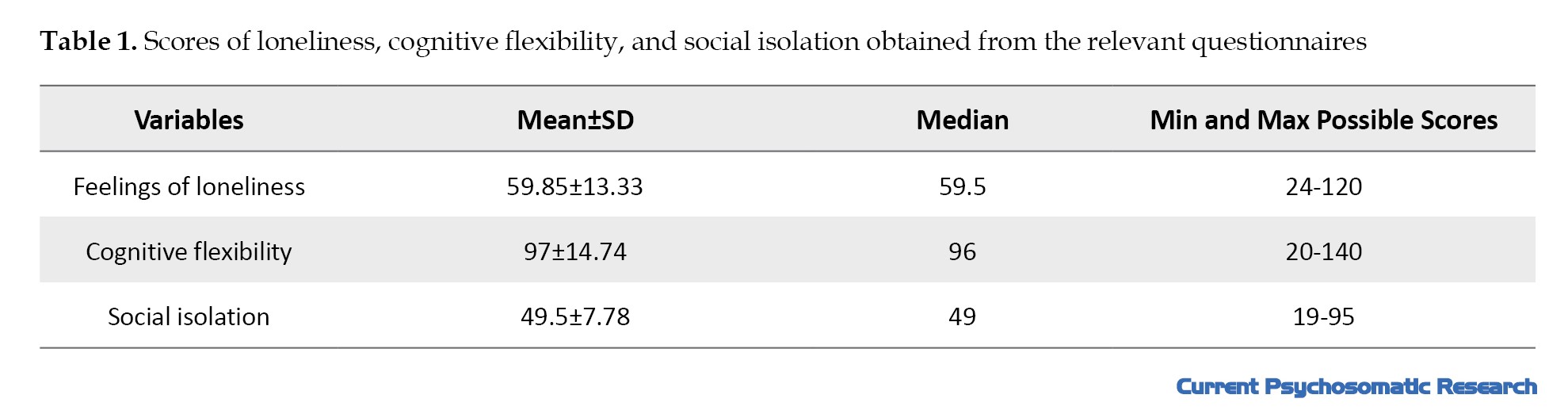
The mean score for loneliness was 59.85±13.33, which—according to the corresponding questionnaire—falls within the moderate loneliness range (48–72). The mean cognitive flexibility score was 97.0±14.74; given that the minimum and maximum possible scores on this questionnaire are 20 to 140, this also falls within the moderate range. Finally, the mean social isolation score was 49.5±7.78; according to the scoring criteria of this questionnaire, scores between 38 and 76 indicate a moderate level. Therefore, social isolation among participants in this study was also at a moderate level (Table 1).
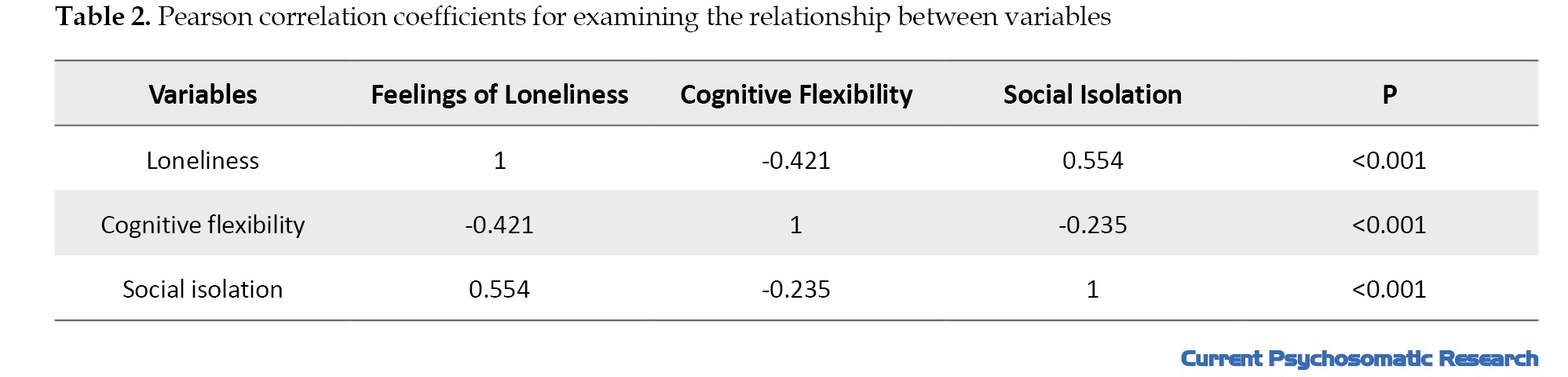
Loneliness had a positive and statistically significant correlation with social isolation (r=0.554). This indicates that as social isolation increases, the level of loneliness also increases.
In addition, loneliness was negatively and significantly correlated with cognitive flexibility (r=–0.421). In other words, individuals with higher cognitive flexibility experience lower levels of loneliness. Social isolation and cognitive flexibility also showed a negative but weak relationship (r=–0.235), although it remains statistically significant (Table 2).
This suggests that higher cognitive flexibility is associated with a relative decrease in social isolation.
Before conducting multiple regression analysis, the main assumptions were checked, including absence of multicollinearity, normality of residuals, independence of errors, and homoscedasticity (constant variance). The multicollinearity diagnostics showed that the variance inflation factor (VIF) values for the predictor variables were 1.06, which is below 5, indicating no multicollinearity problem among the independent variables.
To assess the normality of residuals, the distribution of standardized residuals was evaluated using skewness and kurtosis indices, as well as the Kolmogorov–Smirnov test. The results indicated that the residuals did not deviate significantly from normality (P=0.253).
For testing the homogeneity of error variances, Pagan’s test was used. The results showed that the error variances were constant; therefore, the assumption of homoscedasticity was satisfied (P=0.862).
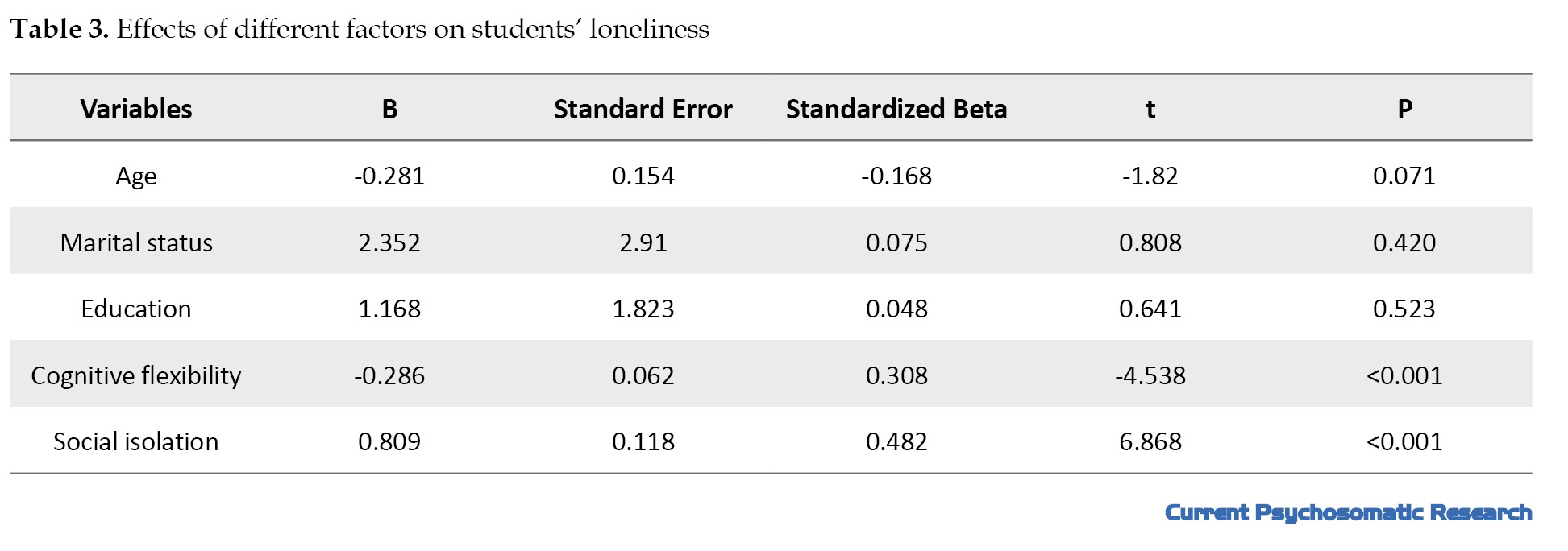
Social isolation (β=0.809) was the strongest predictor of students’ loneliness. It had a direct and statistically significant association, indicating a relatively strong and meaningful relationship. Specifically, approximately with each one-unit increase in social isolation, loneliness increases by 0.809 units (after standardization). Cognitive flexibility (β=−0.286) had a negative and statistically significant relationship with loneliness. Thus, with each one-unit increase in cognitive flexibility, loneliness decreased by 0.286 units. The standardized coefficients indicated that both predictors were significant; however, the effect of cognitive flexibility was slightly smaller than that of social isolation. In addition, the variables age, marital status, and education level showed no statistically significant association with loneliness (P>0.05) (Table 3).
Based on the summary of the multiple regression model, the adjusted coefficient of determination (adjusted R²) was 0.388. Therefore, approximately 39% of the variance in loneliness is explained by social isolation and cognitive flexibility in the regression model (P<0.001).
Discussion
The findings of the present study showed that cognitive flexibility had a negative and statistically significant relationship with loneliness, whereas social isolation directly and significantly predicted loneliness. These results can be explained within contemporary theoretical frameworks, particularly the biopsychosocial model, cognitive appraisal theories, and psychological flexibility perspectives. In these frameworks, loneliness is the outcome of the combined influence of individual cognitive factors and social/interpersonal conditions, and it is not limited solely to a lack of social relationships.
From the standpoint of cognitive appraisal theory, cognitive flexibility refers to an individual’s ability to reinterpret stressful situations, shift perspectives, and select adaptive responses. Individuals with higher cognitive flexibility are more likely to appraise events such as social rejection, situational loneliness, or reduced interactions as less of a stable and personal threat; as a result, they tend to show fewer negative emotional reactions [14]. This mechanism may account for why cognitive flexibility in the present study functioned as a protective factor against loneliness.
Regression analysis results showed that cognitive flexibility explained a statistically significant portion of the variance in loneliness. This finding is consistent with previous studies indicating that psychological and cognitive flexibility reduce loneliness by enhancing acceptance, emotion regulation, and problem-solving [15-18]. In other words, cognitive flexibility may operate as a mediating mechanism that buffers the effect of adverse social conditions on loneliness.
In contrast, social isolation was the strongest predictor of loneliness. This result aligns with the biopsychosocial model, which emphasizes the fundamental role of the social context in shaping psychological outcomes [19]. Social isolation can increase loneliness by reducing meaningful interactions, weakening supportive networks, and limiting opportunities for emotional exchange. The present findings are consistent with those of studies by Fallah et al., Azaryan, Mazaahar, and Kalter et al., which showed that social isolation is not only correlated with loneliness but can also lead to broad negative consequences for mental health [20-23].
It is also important to consider the conceptual distinction between social isolation and loneliness when interpreting the results. Social isolation refers to the objective, structural aspects of one’s relationships, whereas loneliness is a subjective, emotional experience related to the perceived quality of relationships [7]. Accordingly, even under conditions of social isolation, high cognitive flexibility may prevent this situation from being transformed into a more severe subjective experience of loneliness—an idea indirectly supported by the present findings.
In the student population context, especially among female students, academic pressures, changes in social roles, and separation from family may increase the risk of social isolation and loneliness. Our results suggest that students with more robust cognitive resources and higher cognitive flexibility are better able to adapt to these challenges and experience lower levels of loneliness. This finding highlights the need for simultaneous attention to both individual-centered interventions (e.g. training in cognitive flexibility skills and emotion regulation) and social interventions (e.g. strengthening interpersonal interactions and social support).
Despite the significant findings, this study has several limitations. The cross-sectional design and the use of convenience sampling limit the ability to draw conclusions about causal relationships, and the results can be interpreted only at the level of association. In addition, the use of self-report measures may expose the study to recall bias and socially desirable responding. It is recommended that future research use longitudinal designs or mediation/moderation models to examine the roles of cognitive and social mechanisms in the development of loneliness with greater precision.
Overall, the results indicated that students’ loneliness results from the interaction between cognitive and social factors. Increased social isolation heightens the risk of experiencing loneliness, whereas cognitive flexibility can function as an effective protective factor. These findings provide an appropriate theoretical and empirical basis for designing preventive programs and psychological interventions aimed at reducing loneliness and promoting students’ mental health.
Social isolation, as a withdrawal from real social interactions, can lead to a sense of lack of support, feelings of not being understood, and ultimately the development of loneliness. The importance of social relationships is not limited to their quantity; rather, their quality and depth play a decisive role. Although social isolation and loneliness often occur simultaneously, they are distinct constructs. Social isolation refers to the absence or reduction of social interactions, whereas loneliness is more closely related to the individual’s subjective perception of the lack of emotional and supportive connections [23].
One limitation of this study is its cross-sectional design. In cross-sectional studies, the descriptive aspect is typically more prominent, and analytical conclusions must therefore be drawn with caution. Because the relationships among the variables were correlational/associational, causality cannot be established. Another limitation is that participants completed multiple questionnaires, meaning the data rely on self-report and memory, which makes the study susceptible to recall bias.
Conclusion
The findings of the present study highlight the importance of two key variables—cognitive flexibility and social isolation—in predicting loneliness. Strengthening cognitive skills and expanding social interactions can be an effective strategy for improving students’ mental health. Overall, the results indicated that increases in social isolation among female students intensify their feelings of loneliness, whereas increases in psychological flexibility may play a protective role against loneliness. Accordingly, interventions, such as enhancing adaptive skills, resilience, and reducing social isolation may be effective in decreasing loneliness in these students.
Ethical Considerations
Compliance with ethical guidelines
This study was approved by the Ethics Committee of the Islamic Azad University, Varamin–Pishva Branch, Pishva, Iran (Code: IR.IAU.VARAMIN.REC.1404.010). All ethical principles were considered in this article. The participants were informed of the purpose of the research and its implementation stages. They were also assured about the confidentiality of their information and were free to leave the study whenever they wished, and if desired, the research results would be available to them. A written consent has been obtained from the subjects. principles of the Helsinki Convention was also observed.
Funding
The paper was extracted from the MA thesis of Zahra Shahsavan, approved by the Department of Psychology, Islamic Azad University, Varamin–Pishva Branch, Pishva, Iran.
Authors' contributions
Conceptualization and supervision: Morteza Andalib Kourayem, and SeyedAhmad SeyedAlinaghi; Data collection: Zahra Shahsavan; Methodology, data analysis, investigation, and writing: All authors; Funding acquisition and resources: Morteza Andalib Kourayem.
Conflict of interest
The authors declared no conflict of interest.
Acknowledgments
The authors hereby extend their sincere thanks and appreciation to all students and to the respected staff of Islamic Azad University, Varamin–Pishva Branch, who assisted us in conducting this study.
In today’s fast-paced and complex world, mental health is considered one of the most important components of quality of life. Students, as a population transitioning from adolescence to adulthood, face a variety of challenges in educational, social, and individual domains. In this context, loneliness—an increasingly prominent psychological problem in the present era—can lead to significant negative consequences for mental health and quality of life [1].
Loneliness can contribute to the development of depression, anxiety, and higher levels of stress. Among different age groups, students are especially more susceptible to feelings of loneliness, particularly in the early years of entering university, due to changes in their living environment, academic and social pressures, and the likelihood of experiencing social isolation [2].
On the other hand, cognitive flexibility—one of the key individual traits—refers to a person’s ability to adapt to and adjust in response to new circumstances and socially stressful situations [3].
Individuals with higher cognitive flexibility can cope more effectively with challenging situations and experience social pressures with less psychological harm [4]. Cognitive flexibility is one of the key factors involved in maintaining and improving mental health, enabling individuals to adapt efficiently to environmental changes, life challenges, and everyday stressors. This ability includes emotional regulation, reframing one’s perspective when facing problems, and selecting appropriate strategies to solve issues [5]. Research also indicates that individuals with greater cognitive flexibility experience lower levels of anxiety and depression and, when confronted with stressful events, demonstrate more adaptive and effective responses [6].
On the other hand, social isolation is recognized as a psychological condition associated with feelings of separation and lack of belonging, and it can strengthen the sense of loneliness. Research has shown that social isolation and loneliness are reciprocally related, and that the absence of positive social relationships can increase feelings of loneliness [7].
Social isolation refers to a state of withdrawal or separation from social interactions, which may be experienced objectively (e.g. a reduction in the number of social relationships) or subjectively (e.g. a perceived lack of belonging or social support). Social isolation can lead to increased feelings of loneliness and psychological problems [8]. Female students may be at greater risk of experiencing loneliness due to life changes, as well as academic and social challenges. Because of social and cultural pressures, this group may be more likely to experience social isolation and reduced cognitive flexibility, which can, in turn, increase feelings of loneliness [9].
This study aimed to examine whether cognitive flexibility and social isolation are significant predictors of loneliness among female students of Islamic Azad University, Varamin–Pishva Branch.
Materials and Methods
Given the subject and the objectives of the present study, this research employed a cross-sectional descriptive–correlational design. Data were collected in the first half of 2025 using convenience sampling. The statistical population included all female students enrolled in Islamic Azad University, Varamin–Pishva Branch, studying in the first half of 2025. The study sample consisted of 150 female students from Islamic Azad University, Varamin–Pishva Branch, who were willing to participate in the study.
Based on the results of a previous study [10], the prevalence of loneliness among students was estimated to be approximately 50% (P=0.50); thus, the sample size was calculated using the Equation 1:
1. N=(Z1-α/2)2×P(1-P)/d2
With an error level of 15% and a precision of d=0.08, the required sample size was calculated as 150.
N= (1.96)2×0.50×0.50/(0.08)2=150
Inclusion criteria were female gender, being a student of the Faculty of Humanities at Islamic Azad University, and having an age range of 18 to 65 years. Exclusion criteria were participants who completed the questionnaires incompletely and those who did not provide appropriate cooperation.
The sampling method was available; first, a list of students eligible for the study was obtained from the university, then the researcher made phone calls to the students from the beginning of the list, and if they expressed consent to the study, the phone call was first recorded and then a link to the questionnaire was sent to them.
The questionnaires in total comprised 63 items, and the average completion time was approximately 20 minutes.
A) The student loneliness feeling scale (SLFS) developed by Asher (1984) consisted of 24 items, scored on a 5-point Likert scale (1 to 5), with a minimum score of 24 and a maximum score of 120. Based on the scoring classification used in Rezaei et al. scores of 24–48 indicate a low level of loneliness; scores of 48–72 indicate a moderate level of loneliness; and scores above 72 indicate a high level of loneliness. The reliability of the SLFS was assessed using Cronbach’s α. The alpha coefficient for the total scale was 0.84, for the emotional loneliness subscale was 0.82, and for the social loneliness subscale was 0.71, indicating satisfactory reliability [11].
B) The cognitive flexibility questionnaire by Dennis and Vander Wal (2010) included 20 items, scored on a 7-point Likert scale ranging from 1 to 7. In Fadeli et al.’s study, Cronbach’s α for this instrument was 0.75. According to this questionnaire and the interpretation of scores, if scores fall within 38–76, the level of the variable is considered moderate [12].
C) The social isolation questionnaire by Chalabi and Amirkafi (2004) consisted of 19 closed-ended items scored on a five-point Likert scale. If scores are between 19 and 38, the level of the variable is low; if scores are between 38 and 76, the level is moderate; and if scores are above 76, the level is considered very good [13]. In the present study, the calculated Cronbach’s α values were as follows: Loneliness=0.86, cognitive flexibility=0.85, and social isolation=0.74, all of which were acceptable.
The dimensions of support in social relationship networks questionnaire assesses both the type of support (informational support, emotional support, esteem support, and instrumental/support services) and the scope of the social network (network size and type of relationship). The overall Cronbach’s α and the alpha coefficients for its subscales were all greater than 0.70.
Independent variables included age, academic level, and marital status. After data collection, the data were entered into SPSS software, version 26. Then, following the assessment of normality assumptions (including the Shapiro–Wilk test, histogram plots, and Q–Q plots), quantitative data were reported as means and standard deviations, and qualitative data were reported as frequencies and percentages. To examine the pairwise relationship between different variables, Pearson’s correlation coefficients were used. In addition, to evaluate the effects of various factors on the outcome variable, a linear regression model was applied. Before conducting multiple regression analysis, the key assumptions were checked, including no multicollinearity, normality of residuals, independence of errors, and homogeneity of variances. A P=0.05 was considered as the level of statistical significance.
Results
Overall, 142 female students were enrolled in the study; most of them (76.8%) were single, and the remaining were married. The mean age of the students was 7.96±25 years. Regarding academic level, 74.7% were undergraduate, 23.9% were postgraduate (master’s), and 1.4% were doctoral students.
The mean score for loneliness was 59.85±13.33, which—according to the corresponding questionnaire—falls within the moderate loneliness range (48–72). The mean cognitive flexibility score was 97.0±14.74; given that the minimum and maximum possible scores on this questionnaire are 20 to 140, this also falls within the moderate range. Finally, the mean social isolation score was 49.5±7.78; according to the scoring criteria of this questionnaire, scores between 38 and 76 indicate a moderate level. Therefore, social isolation among participants in this study was also at a moderate level (Table 1).
Loneliness had a positive and statistically significant correlation with social isolation (r=0.554). This indicates that as social isolation increases, the level of loneliness also increases.
In addition, loneliness was negatively and significantly correlated with cognitive flexibility (r=–0.421). In other words, individuals with higher cognitive flexibility experience lower levels of loneliness. Social isolation and cognitive flexibility also showed a negative but weak relationship (r=–0.235), although it remains statistically significant (Table 2).
This suggests that higher cognitive flexibility is associated with a relative decrease in social isolation.
Before conducting multiple regression analysis, the main assumptions were checked, including absence of multicollinearity, normality of residuals, independence of errors, and homoscedasticity (constant variance). The multicollinearity diagnostics showed that the variance inflation factor (VIF) values for the predictor variables were 1.06, which is below 5, indicating no multicollinearity problem among the independent variables.
To assess the normality of residuals, the distribution of standardized residuals was evaluated using skewness and kurtosis indices, as well as the Kolmogorov–Smirnov test. The results indicated that the residuals did not deviate significantly from normality (P=0.253).
For testing the homogeneity of error variances, Pagan’s test was used. The results showed that the error variances were constant; therefore, the assumption of homoscedasticity was satisfied (P=0.862).
Social isolation (β=0.809) was the strongest predictor of students’ loneliness. It had a direct and statistically significant association, indicating a relatively strong and meaningful relationship. Specifically, approximately with each one-unit increase in social isolation, loneliness increases by 0.809 units (after standardization). Cognitive flexibility (β=−0.286) had a negative and statistically significant relationship with loneliness. Thus, with each one-unit increase in cognitive flexibility, loneliness decreased by 0.286 units. The standardized coefficients indicated that both predictors were significant; however, the effect of cognitive flexibility was slightly smaller than that of social isolation. In addition, the variables age, marital status, and education level showed no statistically significant association with loneliness (P>0.05) (Table 3).
Based on the summary of the multiple regression model, the adjusted coefficient of determination (adjusted R²) was 0.388. Therefore, approximately 39% of the variance in loneliness is explained by social isolation and cognitive flexibility in the regression model (P<0.001).
Discussion
The findings of the present study showed that cognitive flexibility had a negative and statistically significant relationship with loneliness, whereas social isolation directly and significantly predicted loneliness. These results can be explained within contemporary theoretical frameworks, particularly the biopsychosocial model, cognitive appraisal theories, and psychological flexibility perspectives. In these frameworks, loneliness is the outcome of the combined influence of individual cognitive factors and social/interpersonal conditions, and it is not limited solely to a lack of social relationships.
From the standpoint of cognitive appraisal theory, cognitive flexibility refers to an individual’s ability to reinterpret stressful situations, shift perspectives, and select adaptive responses. Individuals with higher cognitive flexibility are more likely to appraise events such as social rejection, situational loneliness, or reduced interactions as less of a stable and personal threat; as a result, they tend to show fewer negative emotional reactions [14]. This mechanism may account for why cognitive flexibility in the present study functioned as a protective factor against loneliness.
Regression analysis results showed that cognitive flexibility explained a statistically significant portion of the variance in loneliness. This finding is consistent with previous studies indicating that psychological and cognitive flexibility reduce loneliness by enhancing acceptance, emotion regulation, and problem-solving [15-18]. In other words, cognitive flexibility may operate as a mediating mechanism that buffers the effect of adverse social conditions on loneliness.
In contrast, social isolation was the strongest predictor of loneliness. This result aligns with the biopsychosocial model, which emphasizes the fundamental role of the social context in shaping psychological outcomes [19]. Social isolation can increase loneliness by reducing meaningful interactions, weakening supportive networks, and limiting opportunities for emotional exchange. The present findings are consistent with those of studies by Fallah et al., Azaryan, Mazaahar, and Kalter et al., which showed that social isolation is not only correlated with loneliness but can also lead to broad negative consequences for mental health [20-23].
It is also important to consider the conceptual distinction between social isolation and loneliness when interpreting the results. Social isolation refers to the objective, structural aspects of one’s relationships, whereas loneliness is a subjective, emotional experience related to the perceived quality of relationships [7]. Accordingly, even under conditions of social isolation, high cognitive flexibility may prevent this situation from being transformed into a more severe subjective experience of loneliness—an idea indirectly supported by the present findings.
In the student population context, especially among female students, academic pressures, changes in social roles, and separation from family may increase the risk of social isolation and loneliness. Our results suggest that students with more robust cognitive resources and higher cognitive flexibility are better able to adapt to these challenges and experience lower levels of loneliness. This finding highlights the need for simultaneous attention to both individual-centered interventions (e.g. training in cognitive flexibility skills and emotion regulation) and social interventions (e.g. strengthening interpersonal interactions and social support).
Despite the significant findings, this study has several limitations. The cross-sectional design and the use of convenience sampling limit the ability to draw conclusions about causal relationships, and the results can be interpreted only at the level of association. In addition, the use of self-report measures may expose the study to recall bias and socially desirable responding. It is recommended that future research use longitudinal designs or mediation/moderation models to examine the roles of cognitive and social mechanisms in the development of loneliness with greater precision.
Overall, the results indicated that students’ loneliness results from the interaction between cognitive and social factors. Increased social isolation heightens the risk of experiencing loneliness, whereas cognitive flexibility can function as an effective protective factor. These findings provide an appropriate theoretical and empirical basis for designing preventive programs and psychological interventions aimed at reducing loneliness and promoting students’ mental health.
Social isolation, as a withdrawal from real social interactions, can lead to a sense of lack of support, feelings of not being understood, and ultimately the development of loneliness. The importance of social relationships is not limited to their quantity; rather, their quality and depth play a decisive role. Although social isolation and loneliness often occur simultaneously, they are distinct constructs. Social isolation refers to the absence or reduction of social interactions, whereas loneliness is more closely related to the individual’s subjective perception of the lack of emotional and supportive connections [23].
One limitation of this study is its cross-sectional design. In cross-sectional studies, the descriptive aspect is typically more prominent, and analytical conclusions must therefore be drawn with caution. Because the relationships among the variables were correlational/associational, causality cannot be established. Another limitation is that participants completed multiple questionnaires, meaning the data rely on self-report and memory, which makes the study susceptible to recall bias.
Conclusion
The findings of the present study highlight the importance of two key variables—cognitive flexibility and social isolation—in predicting loneliness. Strengthening cognitive skills and expanding social interactions can be an effective strategy for improving students’ mental health. Overall, the results indicated that increases in social isolation among female students intensify their feelings of loneliness, whereas increases in psychological flexibility may play a protective role against loneliness. Accordingly, interventions, such as enhancing adaptive skills, resilience, and reducing social isolation may be effective in decreasing loneliness in these students.
Ethical Considerations
Compliance with ethical guidelines
This study was approved by the Ethics Committee of the Islamic Azad University, Varamin–Pishva Branch, Pishva, Iran (Code: IR.IAU.VARAMIN.REC.1404.010). All ethical principles were considered in this article. The participants were informed of the purpose of the research and its implementation stages. They were also assured about the confidentiality of their information and were free to leave the study whenever they wished, and if desired, the research results would be available to them. A written consent has been obtained from the subjects. principles of the Helsinki Convention was also observed.
Funding
The paper was extracted from the MA thesis of Zahra Shahsavan, approved by the Department of Psychology, Islamic Azad University, Varamin–Pishva Branch, Pishva, Iran.
Authors' contributions
Conceptualization and supervision: Morteza Andalib Kourayem, and SeyedAhmad SeyedAlinaghi; Data collection: Zahra Shahsavan; Methodology, data analysis, investigation, and writing: All authors; Funding acquisition and resources: Morteza Andalib Kourayem.
Conflict of interest
The authors declared no conflict of interest.
Acknowledgments
The authors hereby extend their sincere thanks and appreciation to all students and to the respected staff of Islamic Azad University, Varamin–Pishva Branch, who assisted us in conducting this study.
References
- Alzahrani F, Zarbah A, Asiri A, Asiri A, Alzahrani S, Alqathradi A, et al. Integrated wellness needs of Saudi university students: mental health as a key determinant of lifestyle and quality of life. Psychiatry Int. 2025; 6(3):106. [DOI:10.3390/psychiatryint6030106]
- Akram U, Drabble J, Irvine K, Allen S, Akram A, Stevenson JC, Gardani M. Prevalence and psychiatric correlates of loneliness in UK university students. Npj Ment Health Res. 4(1), 45. [DOI:10.1038/s44184-025-00144-8]
- Nakhostin-Khayyat M, Borjali M, Zeinali M, Fardi D, Montazeri A. The relationship between self-regulation, cognitive flexibility, and resilience among students: a structural equation modeling. BMC Psychol. 2024; 12(1):337.[DOI:10.1186/s40359-024-01843-1]
- Martin MM, Rubin RB. A new measure of cognitive flexibility. Psychol Rep. 1995; 76(3):1087-94. [DOI:10.2466/pr0.1995.76.2.623]
- Thompson CJ, Martin-Wagar C.A. Cognitive flexibility and emotion regulation in eating disorder patients with comorbid generalized anxiety and posttraumatic stress symptoms. Eat Disord. 2025; 33(5):666-80. [DOI:10.1080/10640266.2024.2405290] [PMID] [PMCID]
- Du M, Peng Y, Li Y, Zhu Y, Yang S, Li J, et al. Effect of trait anxiety on cognitive flexibility: Evidence from event-related potentials and resting-state EEG. Biol Psychol. 2022; 170:108319. [DOI:10.1016/j.biopsycho.2022.108319] [PMID]
- Cacioppo JT, Hawkley LC. Perceived social isolation and cognition. Trend Cogn Sci. 2009; 13(10):447-54. [DOI:10.1016/j.tics.2009.06.005] [PMID] [PMCID]
- Shalchi S. [Social isolation, urban development, and socioeconomic status in Tehran (Persian)]. Soc Sci. 2018; 25(81):1-35. [Link]
- Varaee P, poordad S, Darabi R. [The effect of emotional schema therapy on depression and loneliness in girl’s dormitory students (Persian)]. Rooyesh. 2019; 8(2):95-104. [Link]
- Dagnew B, Dagne H. Year of study as predictor of loneliness among students of University of Gondar. BMC Res Notes. 2019; 12(1):240. [DOI:10.1186/s13104-019-4274-4] [PMID] [PMCID]
- Rezaei AM, Safaee MMA, Sadat-Hashemi FMA. [Psychometric properties of the student loneliness feeling scale (SLFS) (Persian)]. J Clin Psychol. 2013; 5(3):81-90. [Link]
- Dennis JP, Vander Wal JS. The cognitive flexibility inventory: Instrument development and estimates of reliability and validity. Cogn Ther Res 2010; 34(3):241-53. [DOI:10.1007/s10608-009-9276-4]
- Chalabi M, Amir Kafi M. [A multilevel analysis of social isolation (Persian)]. Iran J Soc. 2004; 5(2):3-31. [Link]
- Lazarus RS. Folkman S. Stress, appraisal, and coping. New York: Springer; 1984. [Link]
- Feng F, Li H, Zhang T. The effect of physical activity on the subjective well-being of rural left-behind children: the mediating role of discrimination perceptions and loneliness. BMC Psychol. 2024; 12(1):455. [DOI:10.1186/s40359-024-01950-z] [PMID] [PMCID]
- Akdeniz S, Gültekin Ahçı Z. The role of cognitive flexibility and hope in the relationship between loneliness and psychological adjustment: A moderated mediation model. Educ Dev Psychol. 2023; 40(1):74-85. [DOI:10.1080/20590776.2022.2050460]
- Giovenco D, Shook-Sa BE, Hutson B, Buchanan L, Fisher EB, Pettifor A. Social isolation and psychological distress among southern U.S. college students in the era of COVID-19. PLoS One. 2022; 17(12):e0279485. [DOI:10.1371/journal.pone.0279485] [PMID]
- Bahrampour M, Tolabi A, Masoori S, Soltani F. [The relationship between social networks and social isolation with the mental health of students at Azad University, Khorramabad Branch (Persian)]. J Stud Res Behav Sci. 2021; 4(11):179-93.
- Engel GL. The clinical application of the biopsychosocial model. Am J Psychiatry. 1980; 137(5):535-44. [DOI:10.1176/ajp.137.5.535] [PMID] [PMCID]
- Fallah F, Mansouri Z, Zamani Kokhaloo L. The relationship between maladaptive schemas and feelings of loneliness with the isolation of girls with dysmorphic disorder. Clin Psychol Achiev. 2024; 10(4):1-4. [DOI:10.22055/jacp.2024.47561.1399]
- Azarian M, Asadi Majreh S, Mousavi M. [Structural model of the relationship between mindfulness and loneliness in students with emotional breakdown experience: The mediating role of psychological distress (Persian)]. Rooyesh. 2025; 13(11):115-24. [Link]
- Nazir T, Ousman YI. Loneliness among University students as a growing concerne. J Fam Couns Educ. 2023; 8(2):85-99. [Link]
- Kwan C, Gitimoghaddam M, Collet JP. Effects of social isolation and loneliness in children with neurodevelopmental disabilities: A scoping review. Brain Sci. 2020;10(11):786. [DOI:10.3390/brainsci10110786] [PMID]
Type of Study: Research |
Subject:
Psychology
Received: 2025/09/29 | Accepted: 2026/09/19 | Published: 2026/09/19
Received: 2025/09/29 | Accepted: 2026/09/19 | Published: 2026/09/19
Send email to the article author
| Rights and permissions | |
 |
This work is licensed under a Creative Commons Attribution-NonCommercial 4.0 International License. |
Address: Mazandaran University of Medical Sciences, Moallem Square, Sari, Iran.
Journal Office Tel: +981134343407
Email: cpr mazums.ac.ir
Publisher: Negah Institute for Social Research & Scientific Communication
Publisher Tel: +9821 4535 5555; +9821 4535 5000