Tue, Sep 29, 2026
[Archive]
Volume 3, Issue 2 (Winter 2025)
CPR 2025, 3(2): 87-96 |
Back to browse issues page


Download citation:
BibTeX | RIS | EndNote | Medlars | ProCite | Reference Manager | RefWorks
Send citation to:


BibTeX | RIS | EndNote | Medlars | ProCite | Reference Manager | RefWorks
Send citation to:
Heidari Z, Parang S, vatandost S, Zandkrimi E, Hasheminasab L. Empathy and Its Related Factors Among Midwifery Students at Universities in Sanandaj in 2023. CPR 2025; 3 (2) :87-96
URL: http://cpr.mazums.ac.ir/article-1-156-en.html
URL: http://cpr.mazums.ac.ir/article-1-156-en.html


Clinical Care Research Center, Health Development Research Institute, Kurdistan University of Medical Sciences, Sanandaj, Iran.
Full-Text [PDF 696 kb]
(45 Downloads)
| Abstract (HTML) (130 Views)
Full-Text: (32 Views)
Introduction
Empathy is defined as the ability to understand the feelings, thoughts, and social behaviors of others [1]. In other words, an individual interprets another’s situation in such a way that it feels as though they have experienced it themselves [2].
Empathy is a multidimensional construct [3]. It has been conceptualized as the capacity to establish a connection with others’ emotional states and attribute them to a broad range of cognitive abilities; therefore, empathy encompasses both cognitive and affective dimensions [4]. Although affective empathy is relatively stable and more strongly influenced by heredity, cognitive empathy is learnable and is more significantly affected by environmental factors [5].
Establishing empathic communication with a pregnant woman increases her satisfaction and self-confidence while reducing anxiety, psychological stressors, and the fear of natural childbirth [6]. Empathy fosters in the therapist a sense of altruism, flexibility, patience, tolerance, humor, optimism, and kindness. Highly empathic individuals are more likely to achieve greater success in obtaining an accurate case history, conducting effective clinical examinations, requesting appropriate paraclinical tests, performing comprehensive needs assessments, and outlining necessary treatment plans for the patient. Furthermore, empathy reduces students’ internal anxiety and improves their diagnostic performance [7].
In the literature, the primary factors associated with increased empathy include training in communication skills, the use of films and role-playing scenarios, the presence of positive role models, gaining experience through accompanying or interacting with patients, exposure to simulated experiences, and instruction on how to interact empathically [8]. In contrast, difficult tasks, exposure to negative colleague, time pressure from meeting strict deadlines, and the fear of making mistakes tend to reduce empathy levels [9]. Furthermore, burnout, depression, and a reduced quality of life are key factors that influence students’ self-assessment of empathy [10].
As the next generation of healthcare providers, students must be prepared to deliver high-quality, respectful care so that empathy and a dedicated focus on patients’ perspectives are enhanced [11]. Therefore, it is of great importance to assess empathy and teach it to students as an essential skill for providing superior patient care and as an inseparable component of the medical profession [12].
Midwifery students’ empathy skills are currently in the moderate range [5, 12, 13]. Various studies have reported inconsistent results regarding the effects of demographic factors—such as interest in the field of study, age, marital status, academic term, and grade point average—on students’ empathy scores [5, 14, 11, 13]. These inconsistencies and the limitations of existing research regarding the factors related to empathy necessitate a more accurate assessment of this skill, particularly during midwifery education, where the development of students’ communication and professional skills plays a determining role in the quality of future services.
Given the importance of the midwife’s role in providing humanized and empathic care, and because the quality of their communication with pregnant women directly influences the pregnancy and childbirth experience, it is necessary to assess empathy levels in midwifery students and identify related factors. Doing so will help revise educational programs and strengthen their professional skills. Therefore, the present study was designed based on the cognitive-affective model of empathy and was conducted in 2023 to evaluate empathy levels and related factors among midwifery students at universities in Sanandaj.
Materials and Methods
In this cross-sectional study, 232 midwifery students from the School of Nursing and Midwifery and the School of Midwifery at the Kurdistan University of Medical Sciences and the Islamic Azad University, Sanandaj Branch, were enrolled using a census approach. Inclusion criteria included a willingness to participate, the absence of any known mental illness (such as self-reported depression), enrollment in a midwifery program (including bachelor’s degree programs—both continuous and integrated tracks—as well as master’s degree programs), and prior experience working in a labor and delivery ward providing care to pregnant woman. The exclusion criterion was missing responses to more than 20% of the questions; ultimately, no participants were excluded from the study.
Data were collected using a demographic information form consisting of nine items (age, marital status, place of study, history of working in the midwifery profession, educational level, place of residence, pregnancy history, interest in midwifery, and the grade point average of previous terms) and the MES. The MES was developed by Vivilaki et al. in 2016 and includes 22 items. Based on the cognitive-affective model of empathy, the seven subscales of this instrument were categorized into two main dimensions. The cognitive dimension of empathy includes empathetic ways (α=0.577), perspective taking (α=0.592), and standing in the woman’s shoes (α=0.515). The affective dimension includes compassionate care (α=0.731), emotional detachment (α=0.405), interpersonal relationships (α=0.767), and empathic tendencies (α=0.572). Responses were scored on a Likert scale from 1 (completely disagree) to 6 (completely agree). The scoring of items 5, 7, 8, 13, 15, 18, and 22 was reverse-coded. The total score range was 22 to 132, and higher scores indicated greater empathy.
This instrument was translated into Persian and demonstrated acceptable internal consistency, with a Cronbach’s α coefficient of 0.82. Content validity and reliability were previously assessed with a Cronbach’s α of α=0.72 [15]. In the reliability assessment for the present study, the Cronbach’s α for the total questionnaire score was α=0.79.
The internal consistency of the midwifery empathy scale (MES) was assessed using Cronbach’s α. Given that the questionnaire comprises 22 items distributed across seven subscales, the alpha coefficients for some dimensions may fall below the typical threshold due to the limited number of items per subscale. Consequently, the mean inter-item correlation was calculated as a supplementary indicator. This value fell within the acceptable range (0.24–0.4), confirming the relative internal coherence of the construct.
The researcher conducted sampling from July through December 2023. Data were analyzed using SPSS software, version 26. First, data normality was assessed using the Kolmogorov–Smirnov and Shapiro–Wilk tests. Descriptive statistics (frequency, percentage, and measures of central tendency, and mean) were calculated. In the inferential statistics section, because most variables did not follow a normal distribution (P<0.05), non-parametric tests were employed.
For comparisons between two independent groups, the Mann–Whitney U test was applied, while the Kruskal–Wallis test was used for comparisons involving more than two independent groups. To examine associations between quantitative or ordinal variables, Spearman’s correlation coefficient was used, as it serves as a non-parametric alternative to Pearson’s correlation and does not require the assumption of normality or a linear relationship.
Statistical significance was set at α=0.05. To control the family-wise error rate in the multiple tests related to the seven empathy subscales, the Bonferroni correction method was used. The adjusted significance level was 0.007 (0.05 divided by 7). This correction was applied to the set of tests conducted on the empathy dimensions. However, the overall empathy score was treated separately as the primary outcome and was assessed without correction, because the main focus of the study was the total score.
In addition to the non-parametric analyses, a multivariable linear regression analysis was performed using the Enter method. First, the total empathy score was adjusted by dividing it by the number of items (22) to allow for comparison with other studies, resulting in a 6-point scale. Independent variables that demonstrated a P<0.25 in the univariable analyses (specifically, interest in midwifery and cumulative GPA) were included in the model as predictor.
The assumptions of linear regression—including the normality of residuals (assessed via Kolmogorov–Smirnov and Shapiro–Wilk tests, Q–Q plots, and histograms), the absence of multicollinearity (evaluated through VIF and condition index), the independence of residuals (Durbin–Watson test), and homoscedasticity—were all evaluated and confirmed.
Results
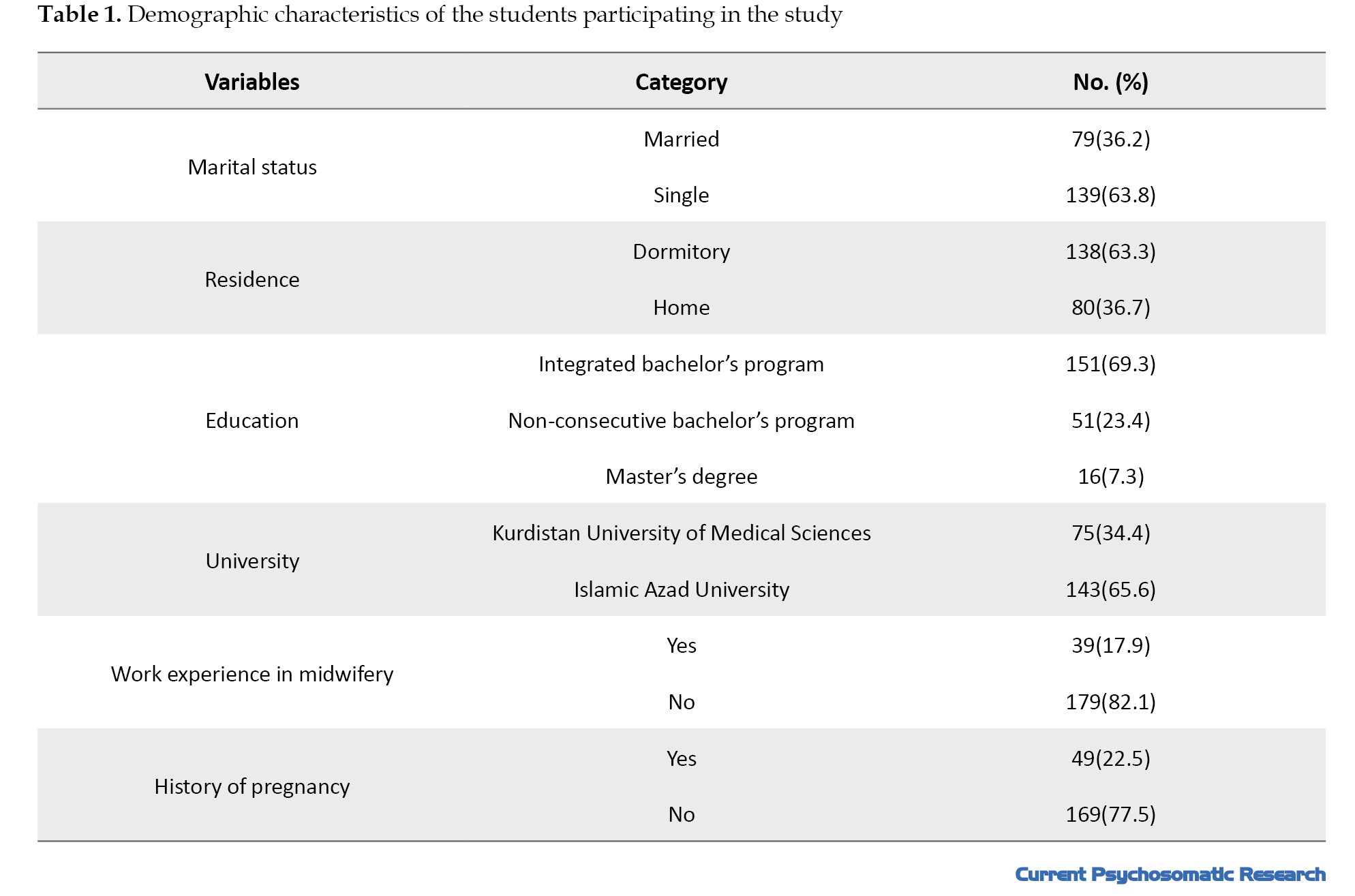
A total of 218 fully completed questionnaires were included in the analysis, representing a student participation rate of 94%. The mean age of the students was 27.22±7.8 years (range: 19–54). Most participants were single (63.8%). The majority of the sample studied at Islamic Azad University (65.6%), had no prior work experience in the midwifery field (82.1%), were enrolled in the integrated bachelor’s program (69.3%), lived in student dormitories (63.3%), and had no history of pregnancy (77.5%). The mean score for interest in midwifery was 6.92±2.2 (range: 0–10), and the mean cumulative GPA from previous terms was 15.86±2.1 (Table 1).
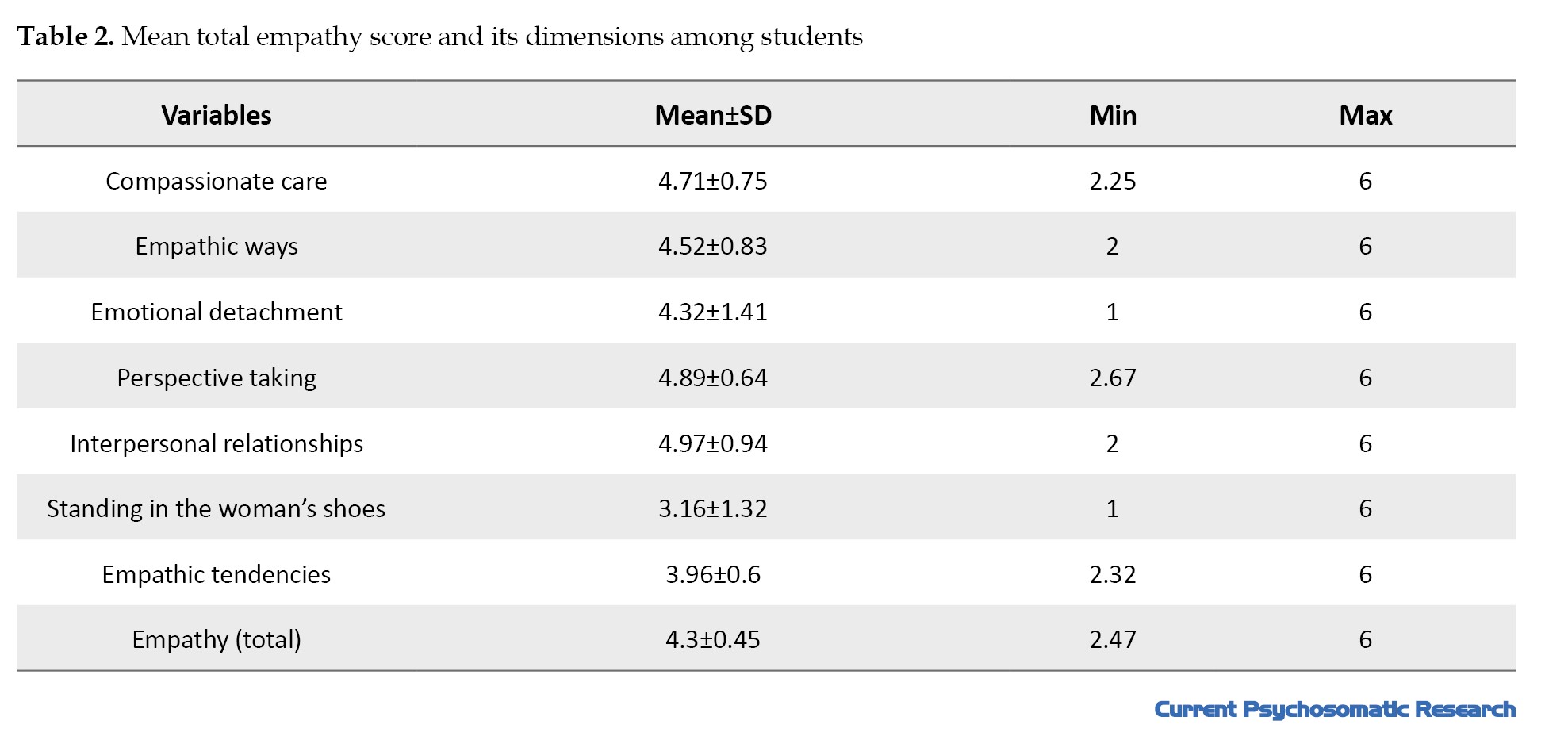
The mean standardized (total) empathy score was 3.4±0.45 (range 1–6). Among the dimensions evaluated, interpersonal relationships received the highest score (4.97±0.94), whereas “standing in the woman’s shoes” received the lowest score (3.16±1.32) (Table 2).
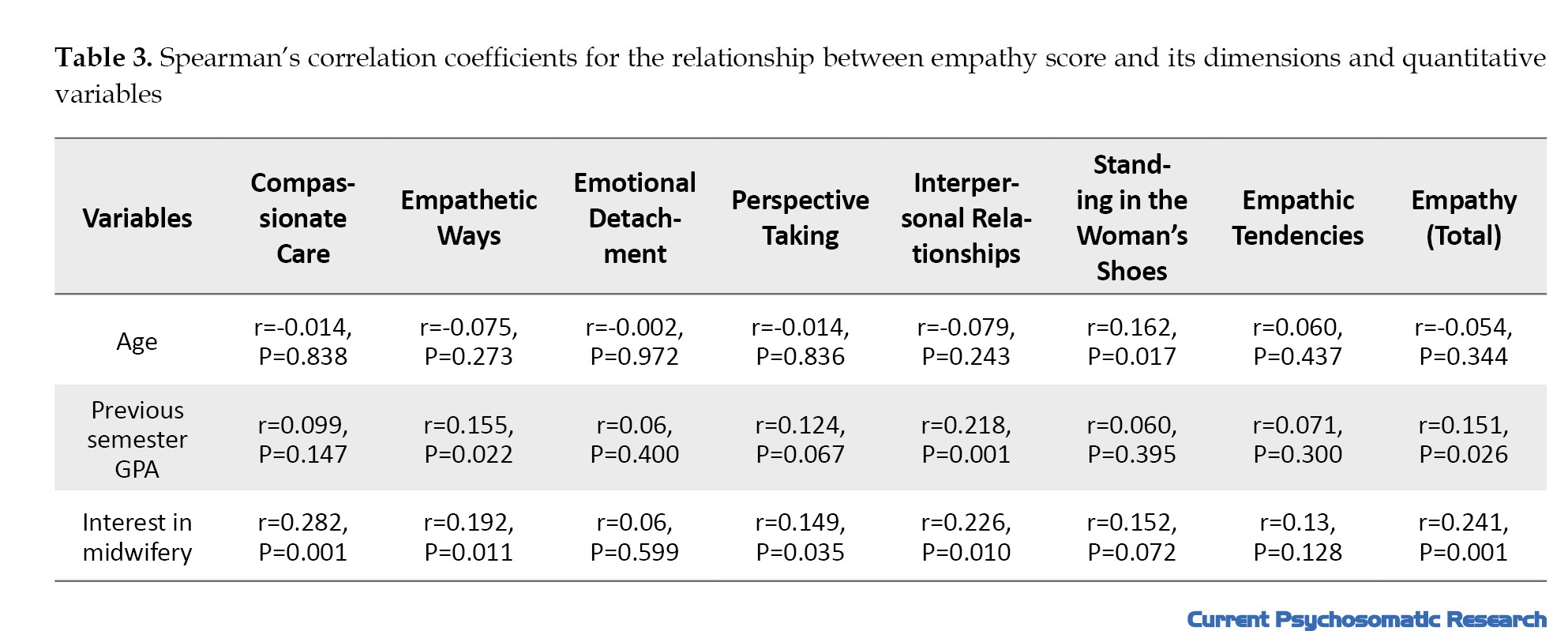
Spearman’s correlation analysis revealed a positive and statistically significant association between the total empathy score and GPA (r=0.151), as well as between total empathy and students’ interest in their field of study (r=0.241). This indicates that empathy levels tend to increase alongside higher GPAs and greater interest in the field. After applying the Bonferroni correction to the empathy dimensions, statistically significant correlations were observed only between the compassionate care dimension and interest in midwifery (r=0.282), and between the interpersonal relationships dimension and GPA (r=0.218). Thus, higher GPAs and increased interest were specifically associated with higher empathy levels in compassionate care and interpersonal relationships. It should be noted, however, that despite achieving statistical significance, the effect sizes of these correlations were very weak (Table 3).
As shown in Table 4, after applying the Bonferroni correction, significant differences were observed in the “standing in the woman’s shoes” dimension regarding marital status (P=0.006), pregnancy history (P=0.004), and educational level (P=0.001).
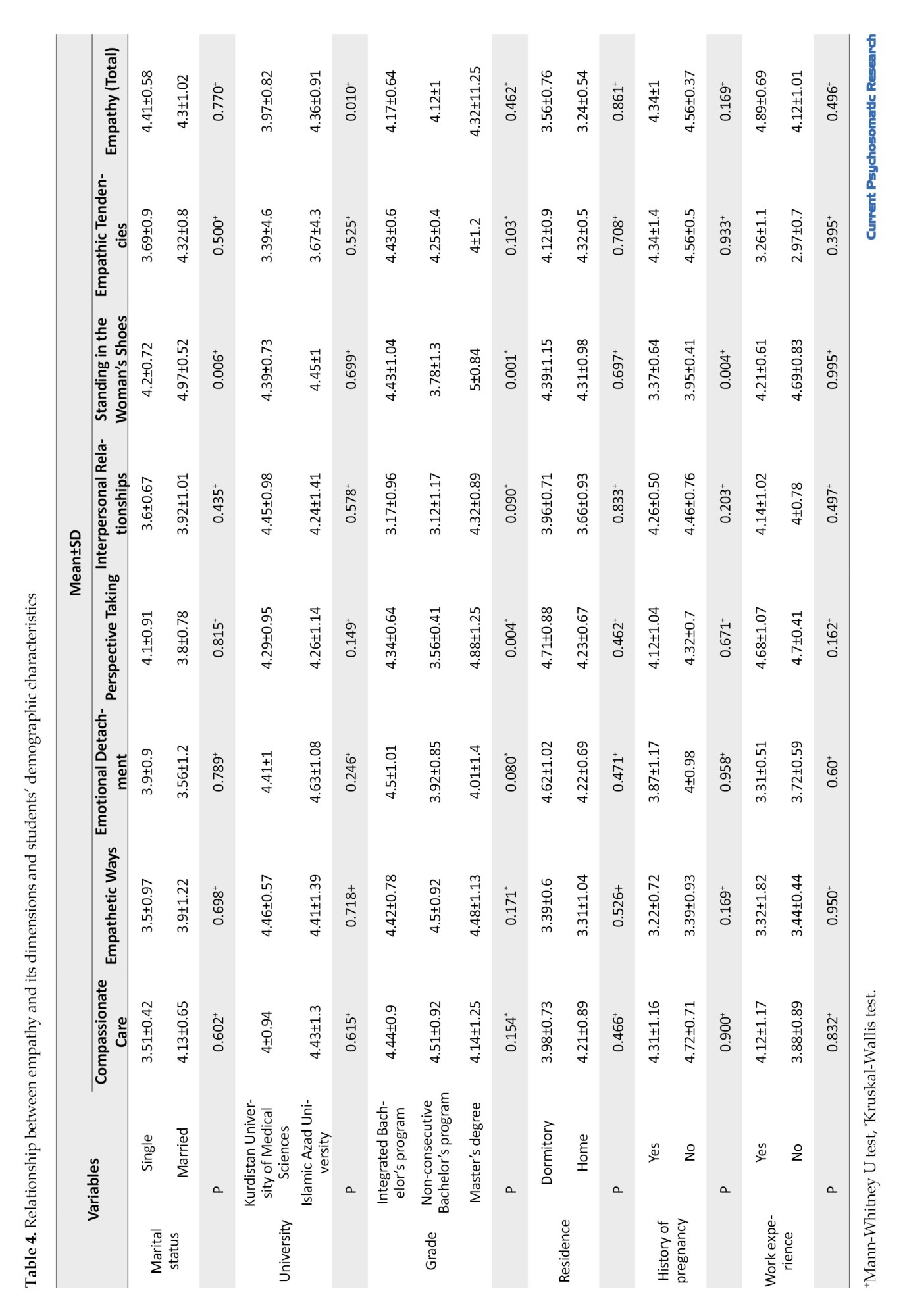
Additionally, significant differences were found in the “perspective taking” dimension based on educational level (P=0.004). No statistically significant differences were found in the total empathy score across any of the qualitative demographic categories (P>0.05).
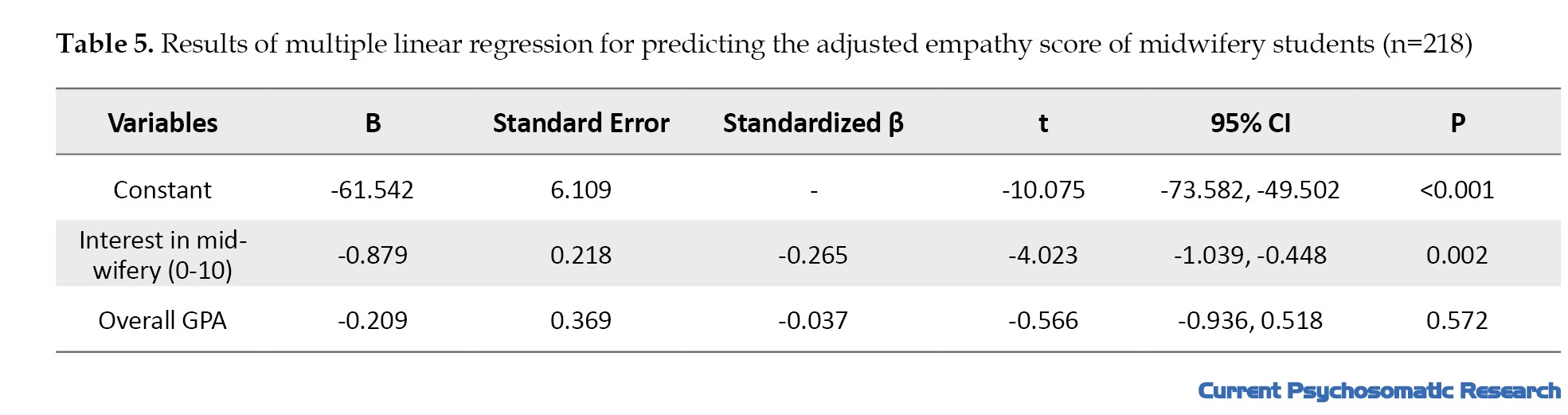
In the multivariable linear regression model, interest in midwifery and cumulative GPA were entered as potential predictors. Within the overall model, interest in midwifery was a significant predictor of the empathy score (P=0.002; β=−0.265), whereas cumulative GPA did not reach statistical significance after controlling for the other variable (P=0.572; β=−0.037) (Table 5).
Discussion
The present study aimed to determine the level of empathy and its associated factors among midwifery students in the universities of Sanandaj in 2023. Overall, students’ empathy levels were higher than the mean total score of the scale, indicating a favorable status regarding their empathy-related skills. This finding is consistent with the results reported by Ezzati et al. [5] and Ashghali Farahani et al. [11]. However, it differs from the study by Erdemoglu et al. [12], which reported lower empathy levels despite using the same research instrument. This discrepancy may be attributable to cultural differences and varying emphasis placed on empathy skill training.
Regarding the specific empathy dimensions, the highest score was observed in the interpersonal relationships dimension, while the lowest score was in the “standing in the woman’s shoes” domain. In other words, while midwifery students demonstrated relatively appropriate performance in verbal communication and expressing empathy through language, they exhibited weaker performance in the more practical aspects of empathy—specifically, the ability to imagine themselves in the situation of a mother during labor. This finding is consistent with the results of Soheili et al. [2].
Based on the framework proposed by Davis, which defines empathy through four dimensions, students scored lower in the “fantasy” dimension, while demonstrating acceptable performance in the “perspective taking” subscale [14-17]. Furthermore, according to another empathy model, although students were relatively successful in expressing affective empathy, they demonstrated greater weakness in cognitive empathy—specifically, the ability to place themselves in the patient’s position and understand the patient’s feelings [17, 18]. These findings highlight the importance of the cognitive component of empathy as a key factor in developing professional competence in midwifery [13].
It is recommended that university instructors encourage students to establish empathetic, compassion-based communication with pregnant women. Lee et al. reported that immersive virtual reality can enhance cognitive empathy by placing individuals in the perspective of others [4].
Regarding educational and motivational factors, the results indicated that interest in midwifery and cumulative GPA from previous terms were positively associated with empathy scores. Although only the association between interest in midwifery was confirmed as a potential predictor in the multivariable linear regression, findings from other studies support this result, suggesting that greater interest in the field and higher academic achievement may strengthen students’ empathy-related skills, self-confidence, and professional commitment [11, 18].
However, this finding is inconsistent with the study by Ezzati et al. [5]. This discrepancy may be explained by differences in research instruments, variations in students’ perspectives, and cultural differences. Motivation to choose midwifery implies that an individual, with an awareness of the nature of care required for specific populations—including women and newborns—enters the profession with commitment, perseverance, and a sense of professional responsibility [19].
Nevertheless, because the correlation coefficients were weak, further investigation in future studies is needed to identify other influential factors. Moreover, after applying the Bonferroni correction to control for Type I error across multiple tests related to the empathy dimensions, some of the weaker correlations became non-significant; however, the primary relationships—particularly the positive associations between the total empathy score and both interest in midwifery and GPA—remained unchanged. This suggests that studies with larger sample sizes are required to further verify these weaker associations.
Master’s-level students obtained higher scores in the “standing in the woman’s shoes” and “perspective taking” dimensions. It should be noted, however, that the strength of these associations was weak. Other studies have reported a negative effect of educational tenure or years of study on empathy levels among midwifery students [18, 20]. This finding suggests that clinical experience and greater interaction with clients, along with increased education level, can help develop cognitive empathy [21].
Regarding individual and social factors, married students and those with a history of pregnancy achieved higher scores in the “standing in the woman’s shoes” dimension. Although this association was statistically significant, its effect size was weak. Findings from comparable studies have supported this result, attributing it to broader social experiences, the influence of parental roles, and the practical application of interpersonal and empathy-related skills [15, 22–25]. The sensitivity that parents employ when adapting their behavior to their children’s needs often persists not only in mother–infant interactions but also in relationships with other individuals [25].
According to the findings, although there was no relationship between employment status and empathy score, the average empathy score was higher in employed students than in unemployed students. The findings of previous studies also confirm the existence of such a relationship between employment and higher levels of empathy [11, 25]. This finding was inconsistent with the results of Hajibabaee et al. [15]. It seems that employment in health, social care, or childcare professions is associated with personality traits, such as extraversion, experientialism, and agreeableness, which make individuals kinder, more empathetic, and more adaptable in interpersonal interactions [17].
It should be noted that several factors affecting students’ empathy were not examined in this study. This limitation underscores the need for qualitative research examining environmental, educational, and interpersonal factors.
Despite the strengths of the study, including the use of an empathy questionnaire specific to the midwifery profession, empathy was assessed through self-report. Thus, the assessment was limited to students’ mental dispositions and attitudes and did not include a detailed evaluation of their clinical skills and actual behaviors. Consequently, participants may have tended to present themselves as more empathetic than they actually were. In addition, the study was conducted among students in a single city with considerable cultural similarities, which limits the generalizability of the findings to the broader population. Therefore, similar studies involving larger populations and assessments of clinical communication skills may produce more accurate results.
The low reliability of some subscales may also affect the interpretation of the findings related to those subscales and highlights the need to revise the instrument or use alternative instruments in future studies. However, the average inter-item correlation was within the acceptable range for most dimensions. In addition, applying the Bonferroni correction made the results more conservative and rendered some marginal relationships statistically insignificant. Future studies should consider using longer versions of the instrument or reexamining its factor structure. It should be noted that the key findings of the study, such as the association between the total empathy score and the main variables, were not affected by this limitation.
Ethical Considerations
Compliance with ethical guidelines
This study was approved by the Ethics Committee of Kurdistan University of Medical Sciences, Sanandaj, Iran (Code: IR.MUK.REC.1402.108)
Funding
This paper was extracted from the master's thesis of Zeinab Heidari, approved by the Department of Midwifery, Faculty of Nursing and Midwifery, Kurdistan University of Medical Sciences, and was supported by the Research Vice-Chancellor of Kurdistan University of Medical Sciences, Sanandaj, Iran.
Authors' contributions
Conceptualization: Zeinab Heidari, Leila Hashemi Nasab, Serveh Parang, and Salam Vatandoost; Methodology: Zeinab Heidari; Formal analysis: Leila Hashemi Nasab and Eghbal Zandkarimi; Validation: Eghbal Zandkarimi; Data curation: Zeinab Heidari; Writing the original draft: Zeinab Heidari; Review and editing: Leila Hashemi Nasab, Serveh Parang, and Salam Vatandoost; Final approval: All authors.
Conflict of interest
The authors declared no conflict of interest.
Acknowledgments
The researchers would like to express their gratitude to the Vice Chancellor for Research, university officials, and the esteemed staff of the School of Nursing and Midwifery at Kurdistan University of Medical Sciences, as well as the students.
Empathy is defined as the ability to understand the feelings, thoughts, and social behaviors of others [1]. In other words, an individual interprets another’s situation in such a way that it feels as though they have experienced it themselves [2].
Empathy is a multidimensional construct [3]. It has been conceptualized as the capacity to establish a connection with others’ emotional states and attribute them to a broad range of cognitive abilities; therefore, empathy encompasses both cognitive and affective dimensions [4]. Although affective empathy is relatively stable and more strongly influenced by heredity, cognitive empathy is learnable and is more significantly affected by environmental factors [5].
Establishing empathic communication with a pregnant woman increases her satisfaction and self-confidence while reducing anxiety, psychological stressors, and the fear of natural childbirth [6]. Empathy fosters in the therapist a sense of altruism, flexibility, patience, tolerance, humor, optimism, and kindness. Highly empathic individuals are more likely to achieve greater success in obtaining an accurate case history, conducting effective clinical examinations, requesting appropriate paraclinical tests, performing comprehensive needs assessments, and outlining necessary treatment plans for the patient. Furthermore, empathy reduces students’ internal anxiety and improves their diagnostic performance [7].
In the literature, the primary factors associated with increased empathy include training in communication skills, the use of films and role-playing scenarios, the presence of positive role models, gaining experience through accompanying or interacting with patients, exposure to simulated experiences, and instruction on how to interact empathically [8]. In contrast, difficult tasks, exposure to negative colleague, time pressure from meeting strict deadlines, and the fear of making mistakes tend to reduce empathy levels [9]. Furthermore, burnout, depression, and a reduced quality of life are key factors that influence students’ self-assessment of empathy [10].
As the next generation of healthcare providers, students must be prepared to deliver high-quality, respectful care so that empathy and a dedicated focus on patients’ perspectives are enhanced [11]. Therefore, it is of great importance to assess empathy and teach it to students as an essential skill for providing superior patient care and as an inseparable component of the medical profession [12].
Midwifery students’ empathy skills are currently in the moderate range [5, 12, 13]. Various studies have reported inconsistent results regarding the effects of demographic factors—such as interest in the field of study, age, marital status, academic term, and grade point average—on students’ empathy scores [5, 14, 11, 13]. These inconsistencies and the limitations of existing research regarding the factors related to empathy necessitate a more accurate assessment of this skill, particularly during midwifery education, where the development of students’ communication and professional skills plays a determining role in the quality of future services.
Given the importance of the midwife’s role in providing humanized and empathic care, and because the quality of their communication with pregnant women directly influences the pregnancy and childbirth experience, it is necessary to assess empathy levels in midwifery students and identify related factors. Doing so will help revise educational programs and strengthen their professional skills. Therefore, the present study was designed based on the cognitive-affective model of empathy and was conducted in 2023 to evaluate empathy levels and related factors among midwifery students at universities in Sanandaj.
Materials and Methods
In this cross-sectional study, 232 midwifery students from the School of Nursing and Midwifery and the School of Midwifery at the Kurdistan University of Medical Sciences and the Islamic Azad University, Sanandaj Branch, were enrolled using a census approach. Inclusion criteria included a willingness to participate, the absence of any known mental illness (such as self-reported depression), enrollment in a midwifery program (including bachelor’s degree programs—both continuous and integrated tracks—as well as master’s degree programs), and prior experience working in a labor and delivery ward providing care to pregnant woman. The exclusion criterion was missing responses to more than 20% of the questions; ultimately, no participants were excluded from the study.
Data were collected using a demographic information form consisting of nine items (age, marital status, place of study, history of working in the midwifery profession, educational level, place of residence, pregnancy history, interest in midwifery, and the grade point average of previous terms) and the MES. The MES was developed by Vivilaki et al. in 2016 and includes 22 items. Based on the cognitive-affective model of empathy, the seven subscales of this instrument were categorized into two main dimensions. The cognitive dimension of empathy includes empathetic ways (α=0.577), perspective taking (α=0.592), and standing in the woman’s shoes (α=0.515). The affective dimension includes compassionate care (α=0.731), emotional detachment (α=0.405), interpersonal relationships (α=0.767), and empathic tendencies (α=0.572). Responses were scored on a Likert scale from 1 (completely disagree) to 6 (completely agree). The scoring of items 5, 7, 8, 13, 15, 18, and 22 was reverse-coded. The total score range was 22 to 132, and higher scores indicated greater empathy.
This instrument was translated into Persian and demonstrated acceptable internal consistency, with a Cronbach’s α coefficient of 0.82. Content validity and reliability were previously assessed with a Cronbach’s α of α=0.72 [15]. In the reliability assessment for the present study, the Cronbach’s α for the total questionnaire score was α=0.79.
The internal consistency of the midwifery empathy scale (MES) was assessed using Cronbach’s α. Given that the questionnaire comprises 22 items distributed across seven subscales, the alpha coefficients for some dimensions may fall below the typical threshold due to the limited number of items per subscale. Consequently, the mean inter-item correlation was calculated as a supplementary indicator. This value fell within the acceptable range (0.24–0.4), confirming the relative internal coherence of the construct.
The researcher conducted sampling from July through December 2023. Data were analyzed using SPSS software, version 26. First, data normality was assessed using the Kolmogorov–Smirnov and Shapiro–Wilk tests. Descriptive statistics (frequency, percentage, and measures of central tendency, and mean) were calculated. In the inferential statistics section, because most variables did not follow a normal distribution (P<0.05), non-parametric tests were employed.
For comparisons between two independent groups, the Mann–Whitney U test was applied, while the Kruskal–Wallis test was used for comparisons involving more than two independent groups. To examine associations between quantitative or ordinal variables, Spearman’s correlation coefficient was used, as it serves as a non-parametric alternative to Pearson’s correlation and does not require the assumption of normality or a linear relationship.
Statistical significance was set at α=0.05. To control the family-wise error rate in the multiple tests related to the seven empathy subscales, the Bonferroni correction method was used. The adjusted significance level was 0.007 (0.05 divided by 7). This correction was applied to the set of tests conducted on the empathy dimensions. However, the overall empathy score was treated separately as the primary outcome and was assessed without correction, because the main focus of the study was the total score.
In addition to the non-parametric analyses, a multivariable linear regression analysis was performed using the Enter method. First, the total empathy score was adjusted by dividing it by the number of items (22) to allow for comparison with other studies, resulting in a 6-point scale. Independent variables that demonstrated a P<0.25 in the univariable analyses (specifically, interest in midwifery and cumulative GPA) were included in the model as predictor.
The assumptions of linear regression—including the normality of residuals (assessed via Kolmogorov–Smirnov and Shapiro–Wilk tests, Q–Q plots, and histograms), the absence of multicollinearity (evaluated through VIF and condition index), the independence of residuals (Durbin–Watson test), and homoscedasticity—were all evaluated and confirmed.
Results
A total of 218 fully completed questionnaires were included in the analysis, representing a student participation rate of 94%. The mean age of the students was 27.22±7.8 years (range: 19–54). Most participants were single (63.8%). The majority of the sample studied at Islamic Azad University (65.6%), had no prior work experience in the midwifery field (82.1%), were enrolled in the integrated bachelor’s program (69.3%), lived in student dormitories (63.3%), and had no history of pregnancy (77.5%). The mean score for interest in midwifery was 6.92±2.2 (range: 0–10), and the mean cumulative GPA from previous terms was 15.86±2.1 (Table 1).
The mean standardized (total) empathy score was 3.4±0.45 (range 1–6). Among the dimensions evaluated, interpersonal relationships received the highest score (4.97±0.94), whereas “standing in the woman’s shoes” received the lowest score (3.16±1.32) (Table 2).
Spearman’s correlation analysis revealed a positive and statistically significant association between the total empathy score and GPA (r=0.151), as well as between total empathy and students’ interest in their field of study (r=0.241). This indicates that empathy levels tend to increase alongside higher GPAs and greater interest in the field. After applying the Bonferroni correction to the empathy dimensions, statistically significant correlations were observed only between the compassionate care dimension and interest in midwifery (r=0.282), and between the interpersonal relationships dimension and GPA (r=0.218). Thus, higher GPAs and increased interest were specifically associated with higher empathy levels in compassionate care and interpersonal relationships. It should be noted, however, that despite achieving statistical significance, the effect sizes of these correlations were very weak (Table 3).
As shown in Table 4, after applying the Bonferroni correction, significant differences were observed in the “standing in the woman’s shoes” dimension regarding marital status (P=0.006), pregnancy history (P=0.004), and educational level (P=0.001).
Additionally, significant differences were found in the “perspective taking” dimension based on educational level (P=0.004). No statistically significant differences were found in the total empathy score across any of the qualitative demographic categories (P>0.05).
In the multivariable linear regression model, interest in midwifery and cumulative GPA were entered as potential predictors. Within the overall model, interest in midwifery was a significant predictor of the empathy score (P=0.002; β=−0.265), whereas cumulative GPA did not reach statistical significance after controlling for the other variable (P=0.572; β=−0.037) (Table 5).
Discussion
The present study aimed to determine the level of empathy and its associated factors among midwifery students in the universities of Sanandaj in 2023. Overall, students’ empathy levels were higher than the mean total score of the scale, indicating a favorable status regarding their empathy-related skills. This finding is consistent with the results reported by Ezzati et al. [5] and Ashghali Farahani et al. [11]. However, it differs from the study by Erdemoglu et al. [12], which reported lower empathy levels despite using the same research instrument. This discrepancy may be attributable to cultural differences and varying emphasis placed on empathy skill training.
Regarding the specific empathy dimensions, the highest score was observed in the interpersonal relationships dimension, while the lowest score was in the “standing in the woman’s shoes” domain. In other words, while midwifery students demonstrated relatively appropriate performance in verbal communication and expressing empathy through language, they exhibited weaker performance in the more practical aspects of empathy—specifically, the ability to imagine themselves in the situation of a mother during labor. This finding is consistent with the results of Soheili et al. [2].
Based on the framework proposed by Davis, which defines empathy through four dimensions, students scored lower in the “fantasy” dimension, while demonstrating acceptable performance in the “perspective taking” subscale [14-17]. Furthermore, according to another empathy model, although students were relatively successful in expressing affective empathy, they demonstrated greater weakness in cognitive empathy—specifically, the ability to place themselves in the patient’s position and understand the patient’s feelings [17, 18]. These findings highlight the importance of the cognitive component of empathy as a key factor in developing professional competence in midwifery [13].
It is recommended that university instructors encourage students to establish empathetic, compassion-based communication with pregnant women. Lee et al. reported that immersive virtual reality can enhance cognitive empathy by placing individuals in the perspective of others [4].
Regarding educational and motivational factors, the results indicated that interest in midwifery and cumulative GPA from previous terms were positively associated with empathy scores. Although only the association between interest in midwifery was confirmed as a potential predictor in the multivariable linear regression, findings from other studies support this result, suggesting that greater interest in the field and higher academic achievement may strengthen students’ empathy-related skills, self-confidence, and professional commitment [11, 18].
However, this finding is inconsistent with the study by Ezzati et al. [5]. This discrepancy may be explained by differences in research instruments, variations in students’ perspectives, and cultural differences. Motivation to choose midwifery implies that an individual, with an awareness of the nature of care required for specific populations—including women and newborns—enters the profession with commitment, perseverance, and a sense of professional responsibility [19].
Nevertheless, because the correlation coefficients were weak, further investigation in future studies is needed to identify other influential factors. Moreover, after applying the Bonferroni correction to control for Type I error across multiple tests related to the empathy dimensions, some of the weaker correlations became non-significant; however, the primary relationships—particularly the positive associations between the total empathy score and both interest in midwifery and GPA—remained unchanged. This suggests that studies with larger sample sizes are required to further verify these weaker associations.
Master’s-level students obtained higher scores in the “standing in the woman’s shoes” and “perspective taking” dimensions. It should be noted, however, that the strength of these associations was weak. Other studies have reported a negative effect of educational tenure or years of study on empathy levels among midwifery students [18, 20]. This finding suggests that clinical experience and greater interaction with clients, along with increased education level, can help develop cognitive empathy [21].
Regarding individual and social factors, married students and those with a history of pregnancy achieved higher scores in the “standing in the woman’s shoes” dimension. Although this association was statistically significant, its effect size was weak. Findings from comparable studies have supported this result, attributing it to broader social experiences, the influence of parental roles, and the practical application of interpersonal and empathy-related skills [15, 22–25]. The sensitivity that parents employ when adapting their behavior to their children’s needs often persists not only in mother–infant interactions but also in relationships with other individuals [25].
According to the findings, although there was no relationship between employment status and empathy score, the average empathy score was higher in employed students than in unemployed students. The findings of previous studies also confirm the existence of such a relationship between employment and higher levels of empathy [11, 25]. This finding was inconsistent with the results of Hajibabaee et al. [15]. It seems that employment in health, social care, or childcare professions is associated with personality traits, such as extraversion, experientialism, and agreeableness, which make individuals kinder, more empathetic, and more adaptable in interpersonal interactions [17].
It should be noted that several factors affecting students’ empathy were not examined in this study. This limitation underscores the need for qualitative research examining environmental, educational, and interpersonal factors.
Despite the strengths of the study, including the use of an empathy questionnaire specific to the midwifery profession, empathy was assessed through self-report. Thus, the assessment was limited to students’ mental dispositions and attitudes and did not include a detailed evaluation of their clinical skills and actual behaviors. Consequently, participants may have tended to present themselves as more empathetic than they actually were. In addition, the study was conducted among students in a single city with considerable cultural similarities, which limits the generalizability of the findings to the broader population. Therefore, similar studies involving larger populations and assessments of clinical communication skills may produce more accurate results.
The low reliability of some subscales may also affect the interpretation of the findings related to those subscales and highlights the need to revise the instrument or use alternative instruments in future studies. However, the average inter-item correlation was within the acceptable range for most dimensions. In addition, applying the Bonferroni correction made the results more conservative and rendered some marginal relationships statistically insignificant. Future studies should consider using longer versions of the instrument or reexamining its factor structure. It should be noted that the key findings of the study, such as the association between the total empathy score and the main variables, were not affected by this limitation.
Ethical Considerations
Compliance with ethical guidelines
This study was approved by the Ethics Committee of Kurdistan University of Medical Sciences, Sanandaj, Iran (Code: IR.MUK.REC.1402.108)
Funding
This paper was extracted from the master's thesis of Zeinab Heidari, approved by the Department of Midwifery, Faculty of Nursing and Midwifery, Kurdistan University of Medical Sciences, and was supported by the Research Vice-Chancellor of Kurdistan University of Medical Sciences, Sanandaj, Iran.
Authors' contributions
Conceptualization: Zeinab Heidari, Leila Hashemi Nasab, Serveh Parang, and Salam Vatandoost; Methodology: Zeinab Heidari; Formal analysis: Leila Hashemi Nasab and Eghbal Zandkarimi; Validation: Eghbal Zandkarimi; Data curation: Zeinab Heidari; Writing the original draft: Zeinab Heidari; Review and editing: Leila Hashemi Nasab, Serveh Parang, and Salam Vatandoost; Final approval: All authors.
Conflict of interest
The authors declared no conflict of interest.
Acknowledgments
The researchers would like to express their gratitude to the Vice Chancellor for Research, university officials, and the esteemed staff of the School of Nursing and Midwifery at Kurdistan University of Medical Sciences, as well as the students.
References
- Mohammadi A, Kamali K. Measuring patients’ perceived empathy of clinical nurses. J Iran Med Counc. 2021; 4(2):64-71. [DOI:10.18502/jimc.v4i2.6459]
- Soheili F, Taheri A, Hosseinian S, Nooripour R. [Comparison of the relationship between patient-patient empathy and birth order in medical students in Iran and England: Cross-cultural study (Persian)]. Iran J Med Ethic Hist Med. 2019; 12(0):151-60. [Link]
- Vivilaki V, Fifli P, Charitou A, Giaxi P, Ekizoglou C, Tsopelas N, et al. Midwifery empathy scale: Development and validation for a greek sample. J Compassionate Health Care. 2016; 3(1):1-9. [DOI:10.1186/s40639-016-0029-4]
- Lee Y, Shin H, Gil YH. Measurement of empathy in virtual reality with head-mounted displays: A systematic review. IEEE Trans Vis Comput Graph. 2024; 30(5):2485-95. [DOI:10.1109/tvcg.2024.3372076 PMID: 38437085.] [PMID]
- Ezzati R, Tafazoli M, Mazloum S, Asgharpour N. [Assessment of empathy skills in midwifery students and its relationship with some of the demographic factors (Persian)]. J Urmia Nurs Midwifery Fac. 2018; 16(2):139-48. [Link]
- Partovi P, Alaee A, Kharazi Fard M. Assessment of the attitude of undergraduate dental students and interns towards empathy in Dental Faculty of Tehran Islamic Azad University in 2020. JSSUMS. 2022; 30(3):4641-55. [DOI:10.18502/ssu.v30i3.9462]
- Hojat M, Maio V, Pohl CA, Gonnella JS. Clinical empathy: definition, measurement, correlates, group differences, erosion, enhancement, and healthcare outcomes. Disc Health Syst. 2023; 2(1):8. [DOI:10.1007/s44250-023-00020-2]
- Bas-Sarmiento P, Fernández-Gutiérrez M, Baena-Baños M, Correro-Bermejo A, Soler-Martins PS, de la Torre-Moyano S. Empathy training in health sciences: A systematic review. Nurse Educ Pract. 2020; 44:102739. [DOI:10.1016/j.nepr.2020.102739] [PMID]
- Cairns P, Isham AE, Zachariae R. The association between empathy and burnout in medical students: A systematic review and meta-analysis. BMC Med Educ. 2024; 24(1):640. [DOI:10.1186/s12909-024-05625-6.] [PMID] [PMCID]
- Kruk ME, Kujawski S, Mbaruku G, Ramsey K, Moyo W, Freedman LP. Disrespectful and abusive treatment during facility delivery in Tanzania: A facility and community survey. Health Policy Plan. 2018; 33(1):e26-33. [DOI:10.1093/heapol/czu079 PMID: 29304252.] [PMID] [PMCID]
- Ashghali Farahani M, Salehi T, Arab Ameri Z, Hajibabaee F, Hosseini F, Ghaffari F. [Empathy among undergraduate nursing students in Tehran University of Medical Sciences (Persian)]. IJMEHM. 2016; 9(4):56-67. [Link]
- Erdemoglu C, Boybay Koyuncu S, Sahin T. [The effects of the empathy levels of midwifery students on their caring behaviors (Persian)]. Perspect Psychiatr Care. 2023; 21(7):1-6. [DOI:10.1155/2023/8990283]
- Ozcan H, Dinçer Y, Poturoğlu B, Kaya S. The comparison of spiritual well-being and empathic tendencies in midwifery students: A cross-sectional study from Turkey. Heliyon. 2024; 10(7):e28691. [DOI:10.1016/j.heliyon.2024.e: 38623233.] [PMID] [PMCID]
- Nunes-Costa R, Lopes C, Leite Â. Parenting and management skills: The mediator role of empathy. Scand J Psychol. 2020; 61(3):388-92. [DOI:10.1111/sjop.12624] [PMID]
- Hajibabaee F, Farahani M, Farahani Z, Salehi T, Hosseini F. The relationship between empathy and emotional intelligence among Iranian nursing students. Int J Med Educ. 2018; 9:239-43. [DOI:10.5116/ijme.5b83.e2a5] [PMID] [PMCID]
- Davis MK. A multidimensional approach to individual. Austin: The University of Texas at Austin: 1980. [Link]
- Sommerlad A, Huntley J, Livingston G, Rankin KP, Fancourt D. Empathy and its associations with age and sociodemographic characteristics in a large UK population sample. Plos One. 2021; 16(9):e0257557. [DOI:10.1371/journal.pone.0257557] [PMID] [PMCID]
- Durmaz Y, Serin E, Onder E, Polat H. Nursing and midwifery students’ perceived care behaviors and empathy tendencies. Turk Stud. 2019; 14(4):2179-93. [Link]
- Sim-Sim M, Zangão O, Barros M, Frias A, Dias H, Santos A, et al. Midwifery now: Narratives about motivations for career choice. Educ Sci. 2022; 12(4):243-51. [DOI:10.3390/educsci12040243]
- Bekmezci H, Yurttas C, Ozkan H. Determination of empathic tendency levels of students receiving education in the department of midwifery. Arch Health Sci Res. 2015; 2(1):46-54. [DOI:10.17681/hsp.30843]
- Bafti S, Bakhshi Pour M. [The relationship between persistence and learning and study strategies in students: The moderating role of educational level (Persian)]. J Educ Psychol. 2024; 14(4):27-38. [Link]
- Maximiano-Barreto MA, Fabrício DM, Luchesi BM, Chagas MHN. Factors associated with levels of empathy among students and professionals in the health field: A systematic review. Trends Psychiatry Psychother. 2020; 42(2):207-15. [DOI:10.1590/2237-6089-2019-0035] [PMID]
- Charitou A, Fifli P, Vivilaki VG. Is empathy an important attribute of midwives and other health professionals?: A review. Eur J Midwifery. 2019; 3:4. [DOI:10.18332/ejm/100612] [PMID]
- Alimohammadi F, Aghajani A. Predicting quality of marital life based on couples commitment, and empathy in married students of Islamic Azad University, Qom Branch. Shenakht J Psychol Psychiatr. 2021; 8(4):135-45. [DOI:10.32598/shenakht.8.4.135]
- Jin Y, WY, Li J. Midwife empathy and its association with the childbirth experience: A cross-sectional study. BMC Pregnanc Childbirth 2022; 22(1): 960-70. [DOI:10.1186/s12884-022-05309-3] [PMID]
Type of Study: Research |
Subject:
Midwifery
Received: 2025/09/19 | Accepted: 2026/09/19 | Published: 2026/09/19
Received: 2025/09/19 | Accepted: 2026/09/19 | Published: 2026/09/19
Send email to the article author
| Rights and permissions | |
 |
This work is licensed under a Creative Commons Attribution-NonCommercial 4.0 International License. |
Address: Mazandaran University of Medical Sciences, Moallem Square, Sari, Iran.
Journal Office Tel: +981134343407
Email: cpr mazums.ac.ir
Publisher: Negah Institute for Social Research & Scientific Communication
Publisher Tel: +9821 4535 5555; +9821 4535 5000