Thu, Oct 1, 2026
[Archive]
Volume 3, Issue 2 (Winter 2025)
CPR 2025, 3(2): 107-116 |
Back to browse issues page



Download citation:
BibTeX | RIS | EndNote | Medlars | ProCite | Reference Manager | RefWorks
Send citation to:


BibTeX | RIS | EndNote | Medlars | ProCite | Reference Manager | RefWorks
Send citation to:
Atashkar Z, Sedaghati kesbakhi M. The Relationship Between Death Anxiety and Life Expectancy and Depression in Patients With Multiple Sclerosis. CPR 2025; 3 (2) :107-116
URL: http://cpr.mazums.ac.ir/article-1-122-en.html
URL: http://cpr.mazums.ac.ir/article-1-122-en.html


Department of Nursing, To. C., Islamic Azad University, Tonekabon, Iran.
Full-Text [PDF 653 kb]
(45 Downloads)
| Abstract (HTML) (154 Views)
Full-Text: (33 Views)
Introduction
Chronic diseases affect various aspects of individuals’ lives [1]. Multiple sclerosis (MS) can cause a range of neurologic symptoms, including blurred vision, muscle weakness, and sensory deficits, resulting from different patterns of axonal damage [2].
The prevalence of MS varies significantly across different regions of the world. In Europe, the United States, New Zealand, and Australia, the prevalence is approximately 1 in 1,000 individuals [3]. While the prevalence of MS in Iran was historically low, recent studies indicate a significant increase. Currently, the prevalence of MS in Iran is moderate and continuing to rise. The prevalence of the disease has been reported at 80 per 100,000 people in Isfahan Province and at least 6 per 100,000 in Sistan and Baluchistan Province [4]. Potential reasons for these regional differences may include greater distance from the equator, genetic factors, lower sun exposure, reduced vitamin D intake, tobacco use, and viral transmission [5]. In Gilan Province, the prevalence of the disease has been reported as 22.5 per 100,000 people [6]. Furthermore, registry data for patients with MS in Mazandaran Province from 2019 to 2021 indicate that the most common MS phenotype in that region is relapsing–remitting MS, accounting for 61.2% of cases, followed by secondary progressive MS at 19.6% [7]. In addition to physical challenges, patients with MS often experience significant cognitive, mood, and behavioral impairments, such as depression and anxiety [8].
Depression, which has a high prevalence among patients with MS, is considered a significant risk factor for increased pain and suffering, reduced treatment adherence, and a diminished quality of life (QoL) [9]. It also exacerbates the severity and frequency of adverse effects associated with pharmacologic treatments—including fatigue, nausea, and cognitive impairment—which further degrades QoL [10]. Failure to recognize and adequately treat depressive symptoms, or neglecting comorbid psychological issues, can result in the worsening of physical symptoms and a decline in the patient’s social functioning. Therefore, the accurate diagnosis, treatment, and follow-up of depressive symptoms are of paramount importance, as these interventions can substantially support the management of physical symptoms [11]. Jafari et al. [12] investigated the relationship between stress, anxiety, depression, and QoL in patients with MS, demonstrating a statistically significant association between patients’ levels of stress, depression, and anxiety and their overall QoL, as well as their scores on physical and psychological subscales.
A relationship exists between death anxiety and depression in patients with MS. Death anxiety is a form of anxiety experienced by living individuals that can affect existential health and, in particular, mental health functioning [13]. Patients with chronic illnesses often report high levels of death anxiety [14]. Khaki et al. [15] examined the relationship between depression, death anxiety, and QoL among elderly residents of Saqqez, demonstrating a statistically significant correlation (r=0.42) between depression, death anxiety, and QoL. Another study compared spiritual health, hope, and death anxiety between two groups—patients with treatable cancer and individuals without cancer—and found a statistically significant difference between the groups, with death anxiety being higher in the cancer cohort [16].
Hanna and Strober [17] examined the backgrounds, consequences, and differential effects of anxiety and depression on the well-being and QoL in patients with MS. Their results indicated that levels of anxiety and depression are high in this population and that anxiety is associated with reduced QoL and poorer sleep quality.
Snyder, the founder of hope theory, defines hope as the ability to generate pathways toward desired goals—despite existing obstacles—combined with the motivational agency necessary to utilize those pathways. Studies have shown that hope can facilitate positive change and enhance an individual’s physical and psychological health. Conversely, a lack of hope can adversely affect mental health and contribute to the development of disease [18]. When individuals possess hope for life, they are more likely to form meaningful relationships, view the future with greater optimism, and—even under the most adverse conditions—focus on positive aspects, connect with others, and continue to engage with life [19].
Shahangian and Areshk [20] investigated the effect of cognitive-behavioral therapy (CBT) on depression and life expectancy in patients with MS, noting that CBT significantly increased hope for life. Although this intervention appeared effective in alleviating symptoms, the reduction in depression was not reported as statistically significant.
Zeidabadinejad [21] examined the effectiveness of meaning therapy on life expectancy and depression among patients with MS affiliated with the MS Patients Support Association in Sirjan. The findings indicated that meaning therapy had a statistically significant impact on both increasing life expectancy and reducing depression.
Asadollahzadeh et al. [22] examined the relationships between disability status, depression, and health-related quality of life among patients with MS in Tehran. Higher disability was associated with poorer physical QOl, whereas greater depression was associated with poorer physical and mental QoL. These findings suggest that, in the absence of adequate support, MS can lead to increased depression and reduced life expectancy in patients. Other studies have also indicated that hope for life is significantly associated with depression and QoL in patients with heart disease. Based on these results, male and female patients with heart disease differed significantly in their levels of life expectancy and QoL [23].
One study assessed the relationship between death anxiety, loneliness, and psychological well-being among elderly residents in nursing homes; the findings revealed that life expectancy significantly influenced death anxiety and QoL in this elderly population [24].
Ochoa-Morales et al. [25] investigated the QoL in patients with MS and its relationship to depressive symptoms and physical disability in MS and related disorders. The challenges arising from MS—including the treatment process, the unpredictability of disease relapses, the inability to manage self-care, concerns regarding treatment costs, and issues such as job loss and medication-related adverse effects—increase patients’ vulnerability to psychological disorders. Research has shown that hope is significantly associated with health-related behaviors, including reduced resistance to treatment, decreased negative emotions, increased adaptive behaviors, and improved medical adherence. The authors argued that the link between hope, health-related behaviors, and medical challenges provides patients with a unique perspective that influences how they cope with the disease [26].
Baxter and Sirois [27] demonstrated that hope influences how patients respond to illness, finding that higher levels of hope in ill individuals predict positive and adaptive responses to the disease. Similarly, a meta-analysis by Ritschel and Cassiello-Robbins [28] concluded that there is a statistically significant negative relationship between life expectancy and depressive symptoms.
Given that depression in patients with MS is associated with multiple consequences—including reduced QoL, decreased treatment adherence, and declines in psychological and social functioning—identifying its contributing factors is of critical importance. Death anxiety, as a core dimension of existential anxiety, can adversely affect the mental health of patients with chronic illnesses. Conversely, hope for life may serve as a protective factor against depression. Therefore, the present study examined the relationships between death anxiety, life expectancy, and depression in patients with MS.
Materials and Methods
The present study is considered an applied research in terms of objectives and is of a descriptive-correlational type in terms of research method. The study population consisted of 320 individuals with MS who had medical records at the MS Association of Tehran and had referred to the association for examinations and treatment procedures between April 2023 and May 2023.
The minimum sample size was determined using G*Power software, version 1.3 for multiple regression analysis, with an effect size of 0.15, a significance level (α) of 0.05, and a power (1−β) of 0.95. Based on these parameters, the minimum required sample size was calculated; ultimately, 173 participants were selected and analyzed using a convenience sampling method.
After obtaining the necessary permissions and coordinating with the center’s management, authorization to conduct the study at the MS Association was granted. During site visits to the MS Association, the research objectives were explained to potential participants. After selecting the sample, patients with MS were invited to complete the research instruments. Participants were assured that all information would be kept strictly confidential and that results would be reported only in aggregate form, without mentioning names or any identifying details.
The demographic information form collected data including age, gender, marital status, educational level, birth order, and disease duration.
Beck depression inventory—second edition
The Beck depression inventory—second edition (BDI-II) consists of 21 items developed by Beck et al. (2000) to measure the behavioral, cognitive, and somatic symptoms of depression [29]. Each item offers four response options, scored on a scale of 0 to 3, which represent varying levels of depressive symptoms ranging from mild to severe. Total scores range from 0 to a maximum of 63. Scores from 0 to 9 indicate no depression or a normal mood; scores of 10 to 16 reflect mild depression; scores of 17 to 29 indicate moderate depression; and scores of 30 to 63 represent severe depression.
In a study of Iranian participants conducted by Fata et al. [30], the Cronbach’s α was reported as 0.91. In the present study, the reliability of this instrument was estimated using Cronbach’s α to be 0.89.
Templer’s death anxiety questionnaire [31]
Developed by Templer in 1979, this 15-item questionnaire consists of statements designed to assess individual attitudes toward death [31]. It utilizes a yes/no response format, with total scores ranging from 0 to 15.
The questionnaire was translated into Persian in 1997. Rajabi and Bahrani reported a Cronbach’s α of 0.89 for this scale [32]. Furthermore, in a study titled “An evaluation of psychometric properties of the Templer’s death anxiety scale-extended among a sample of Iranian chemical warfare veterans,” Sharif Nia et al. demonstrated that the convergent and discriminant validity for all factors of the scale was acceptable. They also reported a Cronbach’s α of 0.88, indicating acceptable construct reliability (exceeding the 0.70 threshold), and an intra-class correlation coefficient (ICC) of 0.87 [33]. In the present study, the Cronbach’s α for this instrument was 0.85.
Snyder’s hope scale [18]
This 12-item scale was developed by Snyder et al. [18] to assess hopefulness. The instrument consists of 12 statements rated on a five-point Likert scale, ranging from “strongly disagree” to “strongly agree.” Administered as a self-report questionnaire, higher scores indicate greater hope for life [18]. The scale’s internal consistency has been reported to range from 0.74 to 0.84. Test re-test reliability is reported at 0.8, with studies indicating that reliability remains higher than this over periods exceeding 8 to 10 weeks [34]. In the present study, reliability was estimated using Cronbach’s α to be 0.9.
Data analysis
Data were analyzed using SPSS software, version 23. Descriptive statistics, including frequency tables, diagrams, measures of central tendency, and measures of dispersion, were used to summarize the data. For inferential statistics, Pearson’s correlation coefficients were applied to examine the relationships between variables, and multiple regression analysis was employed to identify associated factors. The level of statistical significance for this study was set at P<0.05.
Results
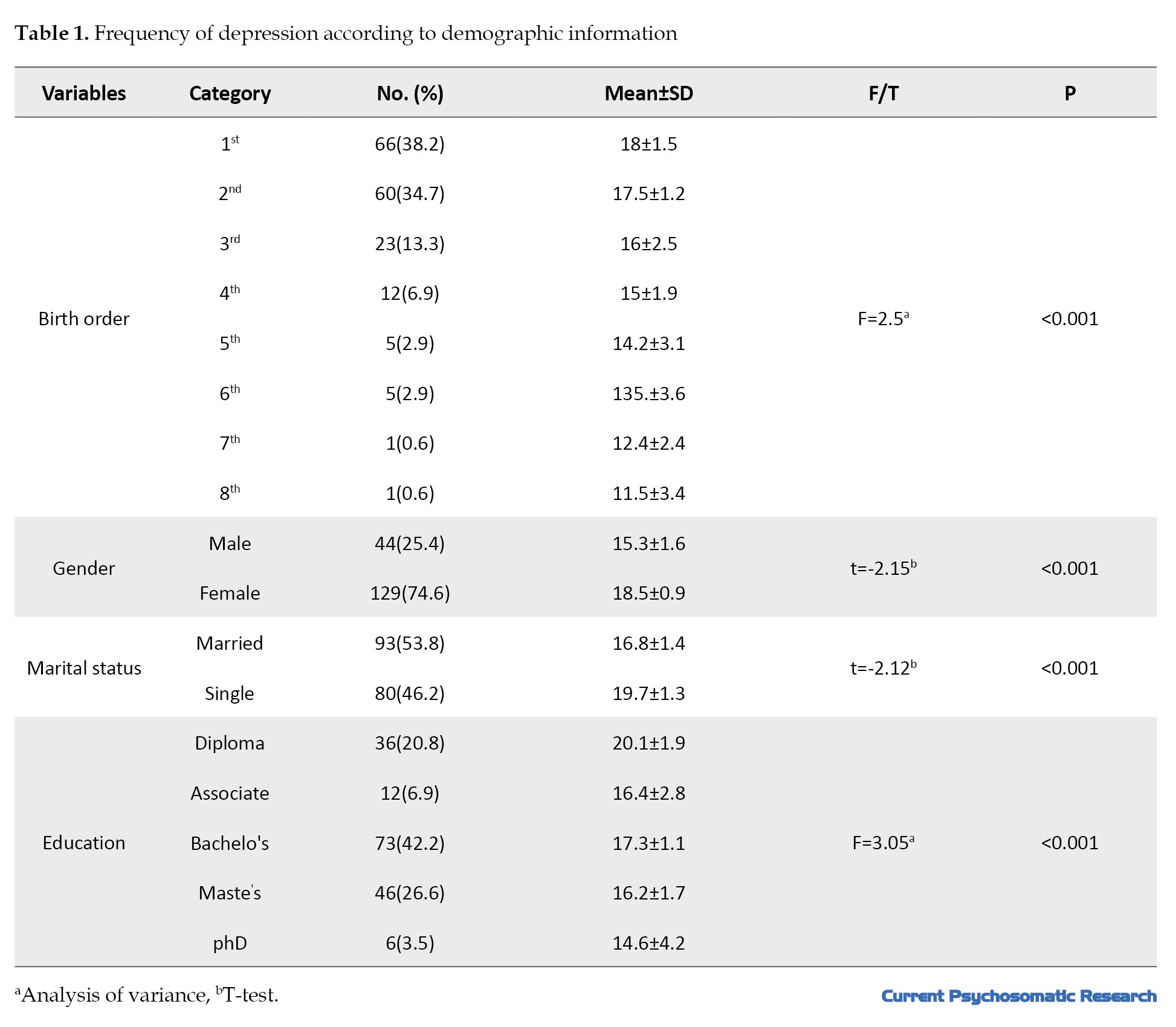
A total of 173 individuals with MS participated in the study, with a mean age of 39.26±5.75 years. The sample included 44 males and 129 females. Regarding marital status, 93 participants were married and 80 were single. In terms of educational attainment, 36 participants held a high school diploma, 12 had an associate degree, 73 held a bachelor’s degree, 46 had a master’s degree, and 6 held a PhD. Regarding birth order, 66 participants were the firstborn, 60 were the second child, 23 were the third, 12 were the fourth, and 5 were the fifth or sixth child, while 1 participant reported being the seventh or eighth child in their family. The mean duration since the participants’ initial diagnosis was 10.68±2.53 years (Table 1).
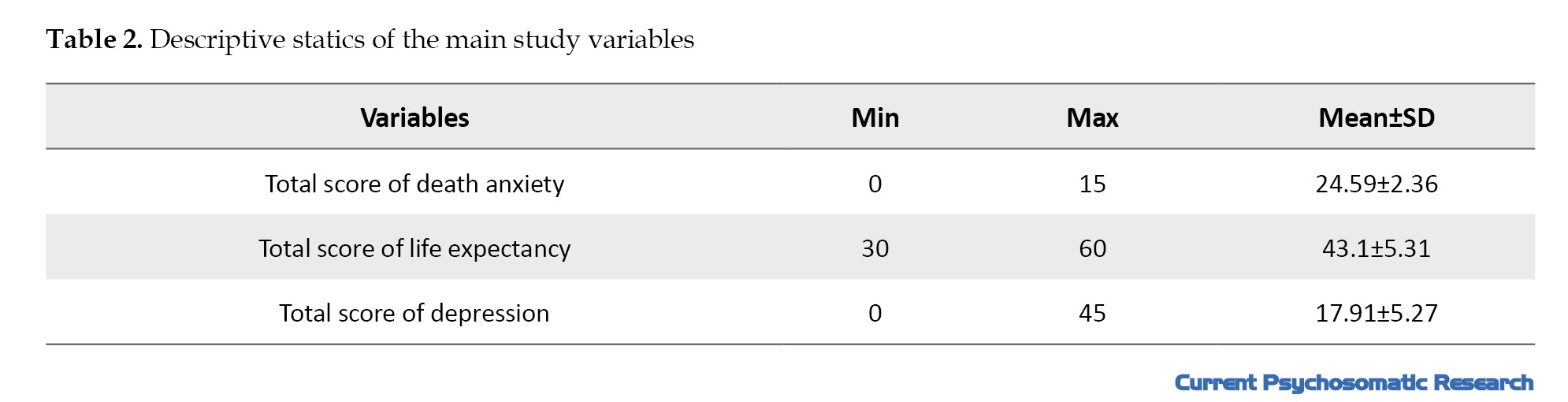
Descriptive statistics for death anxiety, life expectancy, and depression are presented in Table 2.
To evaluate the study’s hypotheses, we examined the relationships between variables using appropriate statistical tests. To conduct parametric comparison and correlation analyses, the assumption of normality was assessed, particularly for the dependent variables. The results of the Kolmogorov–Smirnov test indicated no statistically significant deviations across any of the study variables, confirming that the data were normally distributed. Furthermore, all skewness and kurtosis values fell within the range of −2 to +2, indicating that the variables did not exhibit significant skewness or kurtosis. To test the secondary hypotheses of the study, a correlation matrix was employed.
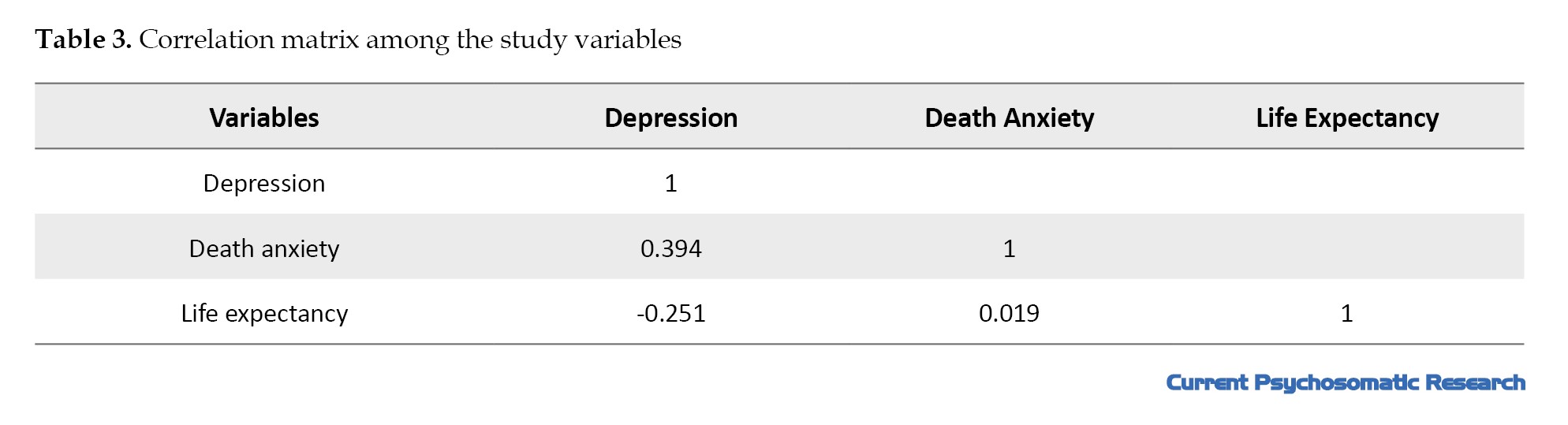
The correlation matrix revealed a statistically significant positive relationship between death anxiety and depression (r=0.394, P<0.001), suggesting that as death anxiety increases, depression levels also increase. Additionally, a statistically significant negative relationship was observed between life expectancy and depression (r=−0.251, P<0.001), indicating that higher life expectancy is associated with lower depression levels. Based on the magnitude of these correlation coefficients, both death anxiety and life expectancy shared a weak association with depression (Table 3).
To examine the contribution of the independent variables in predicting depression among patients with MS, a multiple regression analysis was conducted. The multiple correlation coefficient (R) between the set of independent variables and the dependent variable was 0.532, indicating a moderate-to-strong association between the variables and depression.
The adjusted coefficient of determination was 0.258, suggesting that death anxiety, life expectancy, birth order (the number of the child in the family), sex, marital status, and educational level collectively explained 25.8% of the variance in depression scores. The remaining variation is attributable to factors outside the current model.
To ensure the validity of the regression analysis, classical regression assumptions were assessed. The Durbin–Watson statistic was 1.89, which falls within the standard range (1.5 to 2.5), supporting the assumption of no autocorrelation in the residuals. Furthermore, inspection of the Q–Q plot and the scatterplot of standardized residuals against predicted values confirmed that the assumptions of error normality and homoscedasticity (constant variance) were satisfied.
Finally, an analysis of variance (ANOVA) confirmed that the regression model was statistically significant at the P<0.01 level. All variables included in the model were identified as significant predictors of depression within the target population.
Specifically, demographic variables (birth order, marital status, sex, and educational level), alongside death anxiety and life expectancy, significantly predicted depression. Based on the standardized beta coefficients, death anxiety exerted a greater and more direct influence on predicting depression than life expectancy.
As shown in Table 4, when death anxiety and life expectancy were entered simultaneously into the model, they explained 25.8% of the variance in depression (R2=0.284; adjusted R2=0.258).
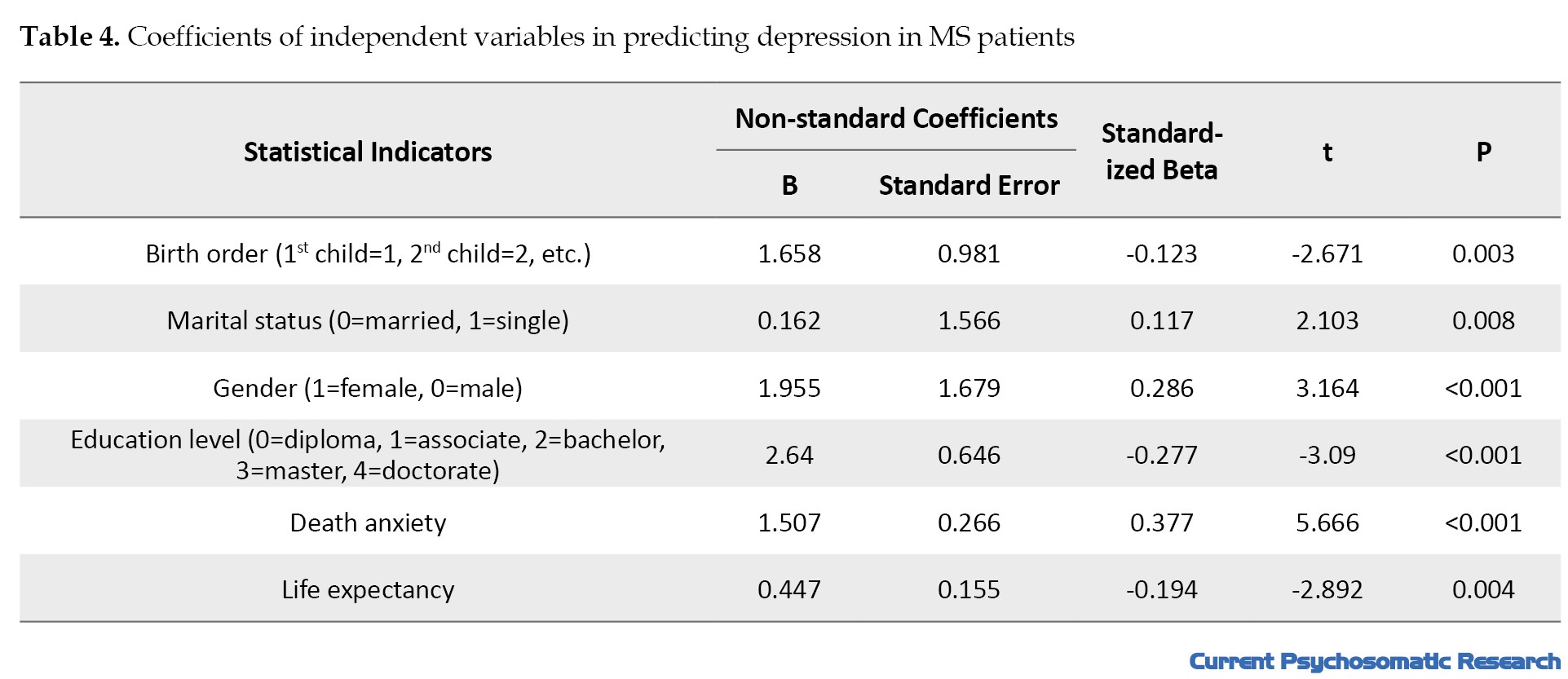
For every one-unit increase in the death anxiety score, depression increased by 1.507 units (B=1.507, P<0.001). Conversely, for every one-unit increase in the life expectancy score, depression decreased by 0.447 units (B=−0.447, P=0.004).
Additionally, the regression coefficients for sex and marital status were positive, indicating that women and single individuals experienced significantly higher levels of depression than men (P<0.001) and married individuals (P=0.008), respectively.
The coefficient for birth order was B=−1.658 (P=0.003), indicating that as birth order increases (e.g. moving from the first-born to the second or third child), the mean depression score decreases by 1.658 units. In other words, children with a lower birth order (i.e. those born earlier in the family) exhibited higher depression scores.
Moreover, the negative coefficient for education (B=−2.64, P<0.001) indicated that higher levels of education are associated with decreased depression levels among patients with MS.
Discussion
The aim of this study was to investigate the relationship between death anxiety, life expectancy, and depression in patients with MS. The results revealed a positive and statistically significant association between death anxiety and depression among MS patients; specifically, higher levels of death anxiety were associated with increased depression scores. These findings are consistent with the results reported by Khaki et al. [15], Esfahan et al. [16], and Ochoa-Morales et al. [25].
A significant inverse relationship was also observed between life expectancy and depression in patients with MS. Accordingly, as depression levels increase, perceived life expectancy decreases. This finding aligns with previous investigations by Stapersma et al. [35], Semenchuk et al. [26], and Morgan et al. [36]. Furthermore, the results indicated that death anxiety was a more potent predictor of depression in MS patients than either demographic variables or life expectancy.
In a related study, death anxiety scores among MS patients were found to be relatively low; however, a moderate association was observed between disability and death anxiety within that population. Additionally, that research indicated that depression was significantly associated with fatigue and disability, and that psychotic and neurocognitive deficits influenced patients’ experiences regarding death [14].
Overall, increasing perceived life expectancy in patients with MS may help mitigate the relationship between death anxiety and depression. By challenging negative automatic thoughts and identifying and correcting cognitive distortions, this approach enables patients to move away from rigid “should/shouldn’t” rules and idealistic beliefs, allowing them to accept their illness and come to terms with it rationally [37].
Furthermore, by modifying cognitions and correcting irrational beliefs, an individual’s attitude toward themselves, the world, and the future is transformed. Consequently, patients may adopt a new perspective characterized by greater flexibility, rather than focusing on their physical limitations and feelings of hopelessness regarding the future.
Several limitations of this study must be acknowledged. First, the reliance on questionnaires and self-report instruments to collect data may have introduced response biases, a concern compounded by the inability to conduct qualitative assessments. Second, the sample was limited to MS patients aged 18 to 60 who were members of the MS Association in Tehran; therefore, the generalizability of these findings to non-members or to MS patients in different geographic regions may be limited. Finally, the scarcity of existing literature made comparing these findings with previous studies difficult, and the study may have been affected by patients’ potentially low motivation or engagement during the completion of the questionnaires.
The failure to account for certain psychological variables—such as client expectations, psychological mindedness and insight, life events coinciding with the study period, client motivation, and concurrent stressors during data collection—as well as demographic variables (e.g. age and socioeconomic status) may threaten the internal validity of this study.
Regarding practical recommendations, given that increased life expectancy is associated with reduced depression in patients, it is suggested that the cognitive dimension be integrated into rehabilitation programs designed for individuals with MS. Furthermore, in light of the role hope plays in the relationship with depression, and considering the numerous studies highlighting the importance of life expectancy in people with chronic conditions, we recommend the development of positive psychology–based interventions for this population. Finally, due to the direct relationship between death anxiety and depression levels, counseling sessions should incorporate strategies specifically designed to help patients manage and reduce death anxiety.
Conclusion
In conclusion, this study demonstrates that as death anxiety increases among individuals, depression also increases; conversely, as perceived life expectancy increases, depression levels decrease. Therefore, clinical efforts should be directed toward developing strategies to enhance life expectancy in these patients. Such interventions might include techniques such as visualizing one’s life in the best possible light, calibrating expectations of an ideal life, setting and documenting personal life goals, emphasizing personal strengths, strengthening supportive relationships, engaging in rewarding activities, and joining purpose-driven social groups. Implementing such interventions may help prevent the onset or exacerbation of depression in patients with MS.
Ethical Considerations
Compliance with ethical guidelines
This study was approved by the Ethics Committee of Tonekabon Branch, Islamic Azad University, Tonekabon, Iran (Ethics Code: IR.IAU.TON.REC.1402.008).Written informed consent was obtained from all participants. To ensure ethical compliance and maintain participant confidentiality, questionnaires were administered anonymously, and each participant was assigned a unique numerical code.
Funding
This study was extracted from the master's thesis of Zohreh Atashkar, approved by the Department of Clinical and Health Psychology, Tonekabon Branch, Islamic Azad University, Tonekabon, Iran. This research did not receive any grant from funding agencies in the public, commercial, or non-profit sectors.
Authors' contributions
Conceptualization, supervision, and writing: Maryam Sedaghati Kesbakhi; Data collection: Zohreh Atashkar; Data curation, interpretation, review, editing and final approval: All authors.
Conflict of interest
The authors declared no conflict of interest.
Acknowledgments
The authors wish to express their sincere gratitude to Islamic Azad University (Tonekabon Branch), the MS Society of Iran, and the participating patients for their cooperation and support in advancing this research.
Chronic diseases affect various aspects of individuals’ lives [1]. Multiple sclerosis (MS) can cause a range of neurologic symptoms, including blurred vision, muscle weakness, and sensory deficits, resulting from different patterns of axonal damage [2].
The prevalence of MS varies significantly across different regions of the world. In Europe, the United States, New Zealand, and Australia, the prevalence is approximately 1 in 1,000 individuals [3]. While the prevalence of MS in Iran was historically low, recent studies indicate a significant increase. Currently, the prevalence of MS in Iran is moderate and continuing to rise. The prevalence of the disease has been reported at 80 per 100,000 people in Isfahan Province and at least 6 per 100,000 in Sistan and Baluchistan Province [4]. Potential reasons for these regional differences may include greater distance from the equator, genetic factors, lower sun exposure, reduced vitamin D intake, tobacco use, and viral transmission [5]. In Gilan Province, the prevalence of the disease has been reported as 22.5 per 100,000 people [6]. Furthermore, registry data for patients with MS in Mazandaran Province from 2019 to 2021 indicate that the most common MS phenotype in that region is relapsing–remitting MS, accounting for 61.2% of cases, followed by secondary progressive MS at 19.6% [7]. In addition to physical challenges, patients with MS often experience significant cognitive, mood, and behavioral impairments, such as depression and anxiety [8].
Depression, which has a high prevalence among patients with MS, is considered a significant risk factor for increased pain and suffering, reduced treatment adherence, and a diminished quality of life (QoL) [9]. It also exacerbates the severity and frequency of adverse effects associated with pharmacologic treatments—including fatigue, nausea, and cognitive impairment—which further degrades QoL [10]. Failure to recognize and adequately treat depressive symptoms, or neglecting comorbid psychological issues, can result in the worsening of physical symptoms and a decline in the patient’s social functioning. Therefore, the accurate diagnosis, treatment, and follow-up of depressive symptoms are of paramount importance, as these interventions can substantially support the management of physical symptoms [11]. Jafari et al. [12] investigated the relationship between stress, anxiety, depression, and QoL in patients with MS, demonstrating a statistically significant association between patients’ levels of stress, depression, and anxiety and their overall QoL, as well as their scores on physical and psychological subscales.
A relationship exists between death anxiety and depression in patients with MS. Death anxiety is a form of anxiety experienced by living individuals that can affect existential health and, in particular, mental health functioning [13]. Patients with chronic illnesses often report high levels of death anxiety [14]. Khaki et al. [15] examined the relationship between depression, death anxiety, and QoL among elderly residents of Saqqez, demonstrating a statistically significant correlation (r=0.42) between depression, death anxiety, and QoL. Another study compared spiritual health, hope, and death anxiety between two groups—patients with treatable cancer and individuals without cancer—and found a statistically significant difference between the groups, with death anxiety being higher in the cancer cohort [16].
Hanna and Strober [17] examined the backgrounds, consequences, and differential effects of anxiety and depression on the well-being and QoL in patients with MS. Their results indicated that levels of anxiety and depression are high in this population and that anxiety is associated with reduced QoL and poorer sleep quality.
Snyder, the founder of hope theory, defines hope as the ability to generate pathways toward desired goals—despite existing obstacles—combined with the motivational agency necessary to utilize those pathways. Studies have shown that hope can facilitate positive change and enhance an individual’s physical and psychological health. Conversely, a lack of hope can adversely affect mental health and contribute to the development of disease [18]. When individuals possess hope for life, they are more likely to form meaningful relationships, view the future with greater optimism, and—even under the most adverse conditions—focus on positive aspects, connect with others, and continue to engage with life [19].
Shahangian and Areshk [20] investigated the effect of cognitive-behavioral therapy (CBT) on depression and life expectancy in patients with MS, noting that CBT significantly increased hope for life. Although this intervention appeared effective in alleviating symptoms, the reduction in depression was not reported as statistically significant.
Zeidabadinejad [21] examined the effectiveness of meaning therapy on life expectancy and depression among patients with MS affiliated with the MS Patients Support Association in Sirjan. The findings indicated that meaning therapy had a statistically significant impact on both increasing life expectancy and reducing depression.
Asadollahzadeh et al. [22] examined the relationships between disability status, depression, and health-related quality of life among patients with MS in Tehran. Higher disability was associated with poorer physical QOl, whereas greater depression was associated with poorer physical and mental QoL. These findings suggest that, in the absence of adequate support, MS can lead to increased depression and reduced life expectancy in patients. Other studies have also indicated that hope for life is significantly associated with depression and QoL in patients with heart disease. Based on these results, male and female patients with heart disease differed significantly in their levels of life expectancy and QoL [23].
One study assessed the relationship between death anxiety, loneliness, and psychological well-being among elderly residents in nursing homes; the findings revealed that life expectancy significantly influenced death anxiety and QoL in this elderly population [24].
Ochoa-Morales et al. [25] investigated the QoL in patients with MS and its relationship to depressive symptoms and physical disability in MS and related disorders. The challenges arising from MS—including the treatment process, the unpredictability of disease relapses, the inability to manage self-care, concerns regarding treatment costs, and issues such as job loss and medication-related adverse effects—increase patients’ vulnerability to psychological disorders. Research has shown that hope is significantly associated with health-related behaviors, including reduced resistance to treatment, decreased negative emotions, increased adaptive behaviors, and improved medical adherence. The authors argued that the link between hope, health-related behaviors, and medical challenges provides patients with a unique perspective that influences how they cope with the disease [26].
Baxter and Sirois [27] demonstrated that hope influences how patients respond to illness, finding that higher levels of hope in ill individuals predict positive and adaptive responses to the disease. Similarly, a meta-analysis by Ritschel and Cassiello-Robbins [28] concluded that there is a statistically significant negative relationship between life expectancy and depressive symptoms.
Given that depression in patients with MS is associated with multiple consequences—including reduced QoL, decreased treatment adherence, and declines in psychological and social functioning—identifying its contributing factors is of critical importance. Death anxiety, as a core dimension of existential anxiety, can adversely affect the mental health of patients with chronic illnesses. Conversely, hope for life may serve as a protective factor against depression. Therefore, the present study examined the relationships between death anxiety, life expectancy, and depression in patients with MS.
Materials and Methods
The present study is considered an applied research in terms of objectives and is of a descriptive-correlational type in terms of research method. The study population consisted of 320 individuals with MS who had medical records at the MS Association of Tehran and had referred to the association for examinations and treatment procedures between April 2023 and May 2023.
The minimum sample size was determined using G*Power software, version 1.3 for multiple regression analysis, with an effect size of 0.15, a significance level (α) of 0.05, and a power (1−β) of 0.95. Based on these parameters, the minimum required sample size was calculated; ultimately, 173 participants were selected and analyzed using a convenience sampling method.
After obtaining the necessary permissions and coordinating with the center’s management, authorization to conduct the study at the MS Association was granted. During site visits to the MS Association, the research objectives were explained to potential participants. After selecting the sample, patients with MS were invited to complete the research instruments. Participants were assured that all information would be kept strictly confidential and that results would be reported only in aggregate form, without mentioning names or any identifying details.
The demographic information form collected data including age, gender, marital status, educational level, birth order, and disease duration.
Beck depression inventory—second edition
The Beck depression inventory—second edition (BDI-II) consists of 21 items developed by Beck et al. (2000) to measure the behavioral, cognitive, and somatic symptoms of depression [29]. Each item offers four response options, scored on a scale of 0 to 3, which represent varying levels of depressive symptoms ranging from mild to severe. Total scores range from 0 to a maximum of 63. Scores from 0 to 9 indicate no depression or a normal mood; scores of 10 to 16 reflect mild depression; scores of 17 to 29 indicate moderate depression; and scores of 30 to 63 represent severe depression.
In a study of Iranian participants conducted by Fata et al. [30], the Cronbach’s α was reported as 0.91. In the present study, the reliability of this instrument was estimated using Cronbach’s α to be 0.89.
Templer’s death anxiety questionnaire [31]
Developed by Templer in 1979, this 15-item questionnaire consists of statements designed to assess individual attitudes toward death [31]. It utilizes a yes/no response format, with total scores ranging from 0 to 15.
The questionnaire was translated into Persian in 1997. Rajabi and Bahrani reported a Cronbach’s α of 0.89 for this scale [32]. Furthermore, in a study titled “An evaluation of psychometric properties of the Templer’s death anxiety scale-extended among a sample of Iranian chemical warfare veterans,” Sharif Nia et al. demonstrated that the convergent and discriminant validity for all factors of the scale was acceptable. They also reported a Cronbach’s α of 0.88, indicating acceptable construct reliability (exceeding the 0.70 threshold), and an intra-class correlation coefficient (ICC) of 0.87 [33]. In the present study, the Cronbach’s α for this instrument was 0.85.
Snyder’s hope scale [18]
This 12-item scale was developed by Snyder et al. [18] to assess hopefulness. The instrument consists of 12 statements rated on a five-point Likert scale, ranging from “strongly disagree” to “strongly agree.” Administered as a self-report questionnaire, higher scores indicate greater hope for life [18]. The scale’s internal consistency has been reported to range from 0.74 to 0.84. Test re-test reliability is reported at 0.8, with studies indicating that reliability remains higher than this over periods exceeding 8 to 10 weeks [34]. In the present study, reliability was estimated using Cronbach’s α to be 0.9.
Data analysis
Data were analyzed using SPSS software, version 23. Descriptive statistics, including frequency tables, diagrams, measures of central tendency, and measures of dispersion, were used to summarize the data. For inferential statistics, Pearson’s correlation coefficients were applied to examine the relationships between variables, and multiple regression analysis was employed to identify associated factors. The level of statistical significance for this study was set at P<0.05.
Results
A total of 173 individuals with MS participated in the study, with a mean age of 39.26±5.75 years. The sample included 44 males and 129 females. Regarding marital status, 93 participants were married and 80 were single. In terms of educational attainment, 36 participants held a high school diploma, 12 had an associate degree, 73 held a bachelor’s degree, 46 had a master’s degree, and 6 held a PhD. Regarding birth order, 66 participants were the firstborn, 60 were the second child, 23 were the third, 12 were the fourth, and 5 were the fifth or sixth child, while 1 participant reported being the seventh or eighth child in their family. The mean duration since the participants’ initial diagnosis was 10.68±2.53 years (Table 1).
Descriptive statistics for death anxiety, life expectancy, and depression are presented in Table 2.
To evaluate the study’s hypotheses, we examined the relationships between variables using appropriate statistical tests. To conduct parametric comparison and correlation analyses, the assumption of normality was assessed, particularly for the dependent variables. The results of the Kolmogorov–Smirnov test indicated no statistically significant deviations across any of the study variables, confirming that the data were normally distributed. Furthermore, all skewness and kurtosis values fell within the range of −2 to +2, indicating that the variables did not exhibit significant skewness or kurtosis. To test the secondary hypotheses of the study, a correlation matrix was employed.
The correlation matrix revealed a statistically significant positive relationship between death anxiety and depression (r=0.394, P<0.001), suggesting that as death anxiety increases, depression levels also increase. Additionally, a statistically significant negative relationship was observed between life expectancy and depression (r=−0.251, P<0.001), indicating that higher life expectancy is associated with lower depression levels. Based on the magnitude of these correlation coefficients, both death anxiety and life expectancy shared a weak association with depression (Table 3).
To examine the contribution of the independent variables in predicting depression among patients with MS, a multiple regression analysis was conducted. The multiple correlation coefficient (R) between the set of independent variables and the dependent variable was 0.532, indicating a moderate-to-strong association between the variables and depression.
The adjusted coefficient of determination was 0.258, suggesting that death anxiety, life expectancy, birth order (the number of the child in the family), sex, marital status, and educational level collectively explained 25.8% of the variance in depression scores. The remaining variation is attributable to factors outside the current model.
To ensure the validity of the regression analysis, classical regression assumptions were assessed. The Durbin–Watson statistic was 1.89, which falls within the standard range (1.5 to 2.5), supporting the assumption of no autocorrelation in the residuals. Furthermore, inspection of the Q–Q plot and the scatterplot of standardized residuals against predicted values confirmed that the assumptions of error normality and homoscedasticity (constant variance) were satisfied.
Finally, an analysis of variance (ANOVA) confirmed that the regression model was statistically significant at the P<0.01 level. All variables included in the model were identified as significant predictors of depression within the target population.
Specifically, demographic variables (birth order, marital status, sex, and educational level), alongside death anxiety and life expectancy, significantly predicted depression. Based on the standardized beta coefficients, death anxiety exerted a greater and more direct influence on predicting depression than life expectancy.
As shown in Table 4, when death anxiety and life expectancy were entered simultaneously into the model, they explained 25.8% of the variance in depression (R2=0.284; adjusted R2=0.258).
For every one-unit increase in the death anxiety score, depression increased by 1.507 units (B=1.507, P<0.001). Conversely, for every one-unit increase in the life expectancy score, depression decreased by 0.447 units (B=−0.447, P=0.004).
Additionally, the regression coefficients for sex and marital status were positive, indicating that women and single individuals experienced significantly higher levels of depression than men (P<0.001) and married individuals (P=0.008), respectively.
The coefficient for birth order was B=−1.658 (P=0.003), indicating that as birth order increases (e.g. moving from the first-born to the second or third child), the mean depression score decreases by 1.658 units. In other words, children with a lower birth order (i.e. those born earlier in the family) exhibited higher depression scores.
Moreover, the negative coefficient for education (B=−2.64, P<0.001) indicated that higher levels of education are associated with decreased depression levels among patients with MS.
Discussion
The aim of this study was to investigate the relationship between death anxiety, life expectancy, and depression in patients with MS. The results revealed a positive and statistically significant association between death anxiety and depression among MS patients; specifically, higher levels of death anxiety were associated with increased depression scores. These findings are consistent with the results reported by Khaki et al. [15], Esfahan et al. [16], and Ochoa-Morales et al. [25].
A significant inverse relationship was also observed between life expectancy and depression in patients with MS. Accordingly, as depression levels increase, perceived life expectancy decreases. This finding aligns with previous investigations by Stapersma et al. [35], Semenchuk et al. [26], and Morgan et al. [36]. Furthermore, the results indicated that death anxiety was a more potent predictor of depression in MS patients than either demographic variables or life expectancy.
In a related study, death anxiety scores among MS patients were found to be relatively low; however, a moderate association was observed between disability and death anxiety within that population. Additionally, that research indicated that depression was significantly associated with fatigue and disability, and that psychotic and neurocognitive deficits influenced patients’ experiences regarding death [14].
Overall, increasing perceived life expectancy in patients with MS may help mitigate the relationship between death anxiety and depression. By challenging negative automatic thoughts and identifying and correcting cognitive distortions, this approach enables patients to move away from rigid “should/shouldn’t” rules and idealistic beliefs, allowing them to accept their illness and come to terms with it rationally [37].
Furthermore, by modifying cognitions and correcting irrational beliefs, an individual’s attitude toward themselves, the world, and the future is transformed. Consequently, patients may adopt a new perspective characterized by greater flexibility, rather than focusing on their physical limitations and feelings of hopelessness regarding the future.
Several limitations of this study must be acknowledged. First, the reliance on questionnaires and self-report instruments to collect data may have introduced response biases, a concern compounded by the inability to conduct qualitative assessments. Second, the sample was limited to MS patients aged 18 to 60 who were members of the MS Association in Tehran; therefore, the generalizability of these findings to non-members or to MS patients in different geographic regions may be limited. Finally, the scarcity of existing literature made comparing these findings with previous studies difficult, and the study may have been affected by patients’ potentially low motivation or engagement during the completion of the questionnaires.
The failure to account for certain psychological variables—such as client expectations, psychological mindedness and insight, life events coinciding with the study period, client motivation, and concurrent stressors during data collection—as well as demographic variables (e.g. age and socioeconomic status) may threaten the internal validity of this study.
Regarding practical recommendations, given that increased life expectancy is associated with reduced depression in patients, it is suggested that the cognitive dimension be integrated into rehabilitation programs designed for individuals with MS. Furthermore, in light of the role hope plays in the relationship with depression, and considering the numerous studies highlighting the importance of life expectancy in people with chronic conditions, we recommend the development of positive psychology–based interventions for this population. Finally, due to the direct relationship between death anxiety and depression levels, counseling sessions should incorporate strategies specifically designed to help patients manage and reduce death anxiety.
Conclusion
In conclusion, this study demonstrates that as death anxiety increases among individuals, depression also increases; conversely, as perceived life expectancy increases, depression levels decrease. Therefore, clinical efforts should be directed toward developing strategies to enhance life expectancy in these patients. Such interventions might include techniques such as visualizing one’s life in the best possible light, calibrating expectations of an ideal life, setting and documenting personal life goals, emphasizing personal strengths, strengthening supportive relationships, engaging in rewarding activities, and joining purpose-driven social groups. Implementing such interventions may help prevent the onset or exacerbation of depression in patients with MS.
Ethical Considerations
Compliance with ethical guidelines
This study was approved by the Ethics Committee of Tonekabon Branch, Islamic Azad University, Tonekabon, Iran (Ethics Code: IR.IAU.TON.REC.1402.008).Written informed consent was obtained from all participants. To ensure ethical compliance and maintain participant confidentiality, questionnaires were administered anonymously, and each participant was assigned a unique numerical code.
Funding
This study was extracted from the master's thesis of Zohreh Atashkar, approved by the Department of Clinical and Health Psychology, Tonekabon Branch, Islamic Azad University, Tonekabon, Iran. This research did not receive any grant from funding agencies in the public, commercial, or non-profit sectors.
Authors' contributions
Conceptualization, supervision, and writing: Maryam Sedaghati Kesbakhi; Data collection: Zohreh Atashkar; Data curation, interpretation, review, editing and final approval: All authors.
Conflict of interest
The authors declared no conflict of interest.
Acknowledgments
The authors wish to express their sincere gratitude to Islamic Azad University (Tonekabon Branch), the MS Society of Iran, and the participating patients for their cooperation and support in advancing this research.
References
- Samiei Siboni F, Alimoradi Z, Atashi V, Alipour M, Khatooni M. Quality of life in different chronic diseases and its related factors. Int J Prev Med. 2019; 10:65. [DOI:10.4103/ijpvm.IJPVM_429_17] [PMID] [PMCID]
- Zaferani Arani H, Alimohammadzadeh K, Abbasi Garravand N, Abbasy Z. Comparison of visual-spatial perception ability in patients with multiple sclerosis (MS) and normal people in Tabriz City. Med Sci J Islam Azad Univ Tehran Med Branch. 2021; 31(3):338-45. [DOI:10.52547/iau.31.3.338]
- Arani HZ, Alimohammadzadeh K, Garravand NA, Abbasy Z. [Comparison of visual-spatial perception ability in patients with multiple sclerosis (MS) and normal people in Tabriz City (Persian)]. Med Sci. 2021; 31(3):338-45. [DOI:10.52547/iau.31.3.338]
- Izadi S, Nikseresht A, Poursadeghfard M. [Epidemiology of multiple sclerosis in fars province (Persian)]. Iran J Epidemiol. 2014; 10(2):56-61. [Link]
- Alfredsson L, Olsson T. Lifestyle and environmental factors in multiple sclerosis. Cold Spring Harb Perspect Med. 2019; 9(4):a028944. [DOI:10.1101/cshperspect.a028944] [PMID] [PMCID]
- Hosseininezhad M, Saadat S, Bakhshipour H, Nasiri P. Prevalence and incidence of multiple sclerosis (MS) in Guilan Province. SSUJournals. 2021; 29(1):3438-47. [DOI:10.18502/ssu.v29i1.5887]
- Baghbanian S M, Hosseinnataj A, Eskandarieh S, Sahraian M. A report of multiple sclerosis registry in Mazandaran Province 2019-2021. J Mazandaran Univ Med Sci. 2022; 32(207):95-101. [Link]
- Jiménez-Morales RM, Broche-Pérez Y, Macías-Delgado Y, Sebrango C, Díaz-Díaz S, Castiñeira-Rodriguez R, et al. Cognitive rehabilitation program in patients with multiple sclerosis: A pilot study. Neurología. 2024; 39(2):135-46. [DOI:10.1016/j.nrl.2021.03.014] [PMID]
- Sparaco M, Lavorgna L, Bonavita S. Psychiatric disorders in multiple sclerosis. J Neurol. 2021; 268:45-60. [DOI:10.1007/s00415-019-09426-6] [PMID]
- Hofmann SG, Curtiss J, Carpenter JK, Kind S. Effect of treatments for depression on quality of life: A meta-analysis. Cogn Behav Ther. 2017; 46(4):265-86. [DOI:10.1080/16506073.2017.1304445] [PMID] [PMCID]
- Chai Y, Sheline YI, Oathes DJ, Balderston NL, Rao H, Yu M. Functional connectomics in depression: Insights into therapies. Trend Cogn Sci. 2023; 27(9):814-32. [DOI:10.1016/j.tics.2023.05.006] [PMID] [PMCID]
- Jafari M, Lotfizadeh M, Hashemi R. [Investigating the relationship between stress, anxiety and depression with the quality of life of patients with multiple sclerosis (Persian)]. Toloo E Behdasht. 2023; 22(1):1-15. [DOI:10.18502/tbj.v22i1.12776]
- Rezvanirad S, Shaker Dioulagh A. [Comparison of self-efficacy, life expectancy and death anxiety in people with and without heart disease (Persian)]. Iran J Cardiovasc Nurs. 2018; 7(2):34-40. [Link]
- Francalancia J, Mavrogiorgou P, Juckel G, Mitrovic T, Kuhle J, Naegelin Y, et al. Death anxiety and attitudes towards death in patients with multiple sclerosis: An exploratory study. Brain Sci. 2021; 11(8):964. [DOI:10.3390/brainsci11080964] [PMID] [PMCID]
- Khaki S, Khesali Z, Farajzadeh M, Dalvand S, Moslemi B, Ghanei Gheshlagh R. [The relationship of depression and death anxiety to the quality of life among the elderly population. Hayat. 2017; 23(2):152-61. [Link]
- Esfahan I. Comparison of spiritual health, life expectancy and death anxiety in two groups of patients with curable cancer and non-cancer patients: Evidence of gender differences. J Health. 2019; 10(3):346-58. [DOI:10.29252/j.health.10.3.346]
- Hanna M, Strober LB. Anxiety and depression in Multiple Sclerosis (MS): Antecedents, consequences, and differential impact on well-being and quality of life. Mult Scler Relat Disord. 2020; 44:102261. [DOI:10.1016/j.msard.2020.102261] [PMID] [PMCID]
- Snyder CR, Harris C, Anderson JR, Holleran SA, Irving LM, Sigmon ST, et al. The will and the ways: Development and validation of an individual-differences measure of hope. J Pers Soc Psychol. 1991; 60(4):570-85. [DOI:10.1037/0022-3514.60.4.570] [PMID] [PMCID]
- Murphy ER. Hope and well-being. Curr Opin Psychol. 2023; 50:101558. [DOI:10.1016/j.copsyc.2023.101558] [PMID]
- Shahangian Sh, Areshk F. [The effectiveness of cognitive behavioral therapy on depression and life expectancy in patients with multiple sclerosis (Persian). paper presented at the 9th Scientific Research Conference on Educational Sciences and Psychology, Social and Cultural Harms of Iran. 13 November 2021. Tehran, Iran [Link]
- Zeidabadinejad F. [The effectiveness of meaning therapy in increasing life expectancy and reducing depression among patients with multiple sclerosis who were members of the Sirjan multiple sclerosis patients support association (Persian)]. Paper presented at: The 6th National Conference on Recent Research in Educational Sciences and Psychology in Iran; Jan 26 2021; Tehran, Iran. [Link]
- Asadollahzadeh E, Ebadi Z, Owji M, Rezaeimanesh N, Sahraian MA, Moghadasi AN. Exploring the relationship between disability status, depression, and quality of life in individuals with multiple sclerosis. Mult Scler Relat Disord. 2024; 87:105629. [DOI:10.1016/j.msard.2024.105629] [PMID]
- Jennings C, Astin F, Prescott E, Hansen T, Gale Chris P, De Bacquer D. Illness perceptions and health literacy are strongly associated with health-related quality of life, anxiety, and depression in patients with coronary heart disease: Results from the EUROASPIRE V cross-sectional survey. Eur J Cardiovasc Nurs. 2023; 22(7):719-29. [DOI:10.1093/eurjcn/zvac105] [PMID]
- Ergin E, Yildirim D, Yildiz CÇ, Usenmez SY. The relationship of death anxiety with loneliness and psychological well-being in the elderly living in a nursing home. Omega. 2023; 88(1):333-46. [DOI:10.1177/00302228221106054] [PMID]
- Ochoa-Morales A, Hernández-Mojica T, Paz-Rodríguez F, Jara-Prado A, Trujillo-De Los Santos Z, Sánchez-Guzmán M, et al. Quality of life in patients with multiple sclerosis and its association with depressive symptoms and physical disability. Mult Scler Relat Disord. 2019; 36:101386. [DOI:10.1016/j.msard.2019.101386] [PMID]
- Semenchuk BN, Kullman SM, Neilson CJ, Ceccarelli L, Boreskie K, Kehler DS, et al. Self-compassion, health behaviors, self-regulation, and affective states among individuals at risk of or diagnosed with a chronic disease: A scoping review. Mindfulness. 2022; 13(5):1085-111. [DOI:10.1007/s12671-021-01821-3]
- Baxter R, Sirois FM. Self‐compassion and psychological distress in chronic illness: A meta‐analysis. Bri J Health Psychol. 2025; 30(1):e12761. [DOI:10.1111/bjhp.12761] [PMID] [PMCID]
- Ritschel LA, Cassiello-Robbins C. Hope and depression and personality disorders. Cur Opin Psychol. 2023; 49:101507. [DOI:10.1016/j.copsyc.2022.101507] [PMID]
- Beck R, McDonald A. Attachment to God: The Attachment to God Inventory, tests of working model correspondence, and an exploration of faith group differences. Jf Psychol Theol. 2004; 32(2):92-103. [DOI:10.1177/009164710403200202]
- Fata L, Birashk B, Atef Vahid MK, Dabson KS. [Meaning assignment structures/schema,emotional states and cognitive processing of emotional information: comparing two conceptual frameworks (Persian)]. Irani J Psych Clin Psycho. 2005: 11 (3): (42): 312-26. [Link]
- Templer DI. The construction and validation of a death anxiety scale. J Gen Psychol. 1970; 82(2):165-77. [DOI:10.1080/00221309.1970.9920634] [PMID]
- Rajabi G, Bahrani M. [Factor analysis of the items of the Templer death anxiety scale (Persian)]. J Psychol. 2002;5(4):331–344. [Link].
- Sharif Nia H, Pahlevan Sharif S, Goudarzian AH, Haghdoost AA, Ebadi A, Soleimani MA. [An evaluation of psychometric properties of the Templer’s death anxiety scale-extended among a sample of Iranian chemical warfare veterans (Persian)]. Hayat. 2016; 22(3):229-44. [Link]
- Sedation S, Mostajeran M, Ghamrani A. [The comparative analysis of hope and optimism among normal students and those suffering from hearing impairment (Persian)]. J Except Educ. 2012; 4(112):18-26. [Link]
- Stapersma L, van den Brink G, van der Ende J, Bodelier AG, van Wering HM, Hurkmans PC, et al. Illness perceptions and depression are associated with health-related quality of life in youth with inflammatory bowel disease. Int J Behav Med. 2019; 26(4):415-26. [DOI:10.1007/s12529-019-09791-6] [PMID] [PMCID]
- Morgan TL, Semenchuk BN, Ceccarelli L, Kullman SM, Neilson CJ, Kehler DS, et al. Self-compassion, adaptive reactions and health behaviours among adults with prediabetes and type 1, type 2 and gestational diabetes: A scoping review. Can J Diab. 2020; 44(6):555-65. e2. [DOI:10.1016/j.jcjd.2020.05.009] [PMID]
- Poursaeid Esfahani M, Mehrabi, H, Neshat Doost HT. Imagery Rescripting for depression: Recent advances and future directions. Clin Psychol Stud. 2024; 14(23):19-42. [DOI:10.22054/jcps.2024.75740.2980]
Type of Study: Research |
Subject:
Psychology
Received: 2024/10/6 | Accepted: 2026/09/19 | Published: 2026/09/19
Received: 2024/10/6 | Accepted: 2026/09/19 | Published: 2026/09/19
Send email to the article author
| Rights and permissions | |
 |
This work is licensed under a Creative Commons Attribution-NonCommercial 4.0 International License. |
Address: Mazandaran University of Medical Sciences, Moallem Square, Sari, Iran.
Journal Office Tel: +981134343407
Email: cpr mazums.ac.ir
Publisher: Negah Institute for Social Research & Scientific Communication
Publisher Tel: +9821 4535 5555; +9821 4535 5000